
Affordable Couples Counseling in NYC - Get Support Today
Comprehensive Counseling Services:
Find Affordable, Accessible, and Specialized Therapy for Mental Health and Relationships
Counseling is a professional, evidence-based set of services that help individuals and couples address emotional, behavioral, and relational challenges by using therapeutic techniques tailored to specific goals. This guide explains the main types of counseling, how online and affordable options expand access, and how culturally competent practitioners adapt methods for diverse relationship needs. Many people struggle with communication breakdowns, anxiety, depression, or the compounded stressors that affect LGBTQ+ and Black couples, and the right counseling approach can provide measurable improvements in well-being and relationship satisfaction. The article maps practical decision steps for choosing services, compares therapeutic modalities, highlights sliding-scale and community resources, and outlines how to evaluate culturally competent counselors. Throughout, readers will find actionable lists, comparison tables, and concise evidence-based explanations to help decide whether individual therapy, couples work, or specialized services best match their needs.
What Are the Different Types of Counseling Services Available?
Different counseling services target distinct goals and relationship dynamics by combining assessment, skill-building, and psychoeducation to address mental health and relational needs. Understanding the core differences—who benefits, typical goals, and session formats—helps people choose appropriate care quickly and confidently. This section defines common service categories, presents a concise comparison table for quick scanning, and leads into how couples therapy achieves measurable improvements.
The following table compares common counseling services, their typical goals, and usual session formats so readers can match needs to services efficiently.
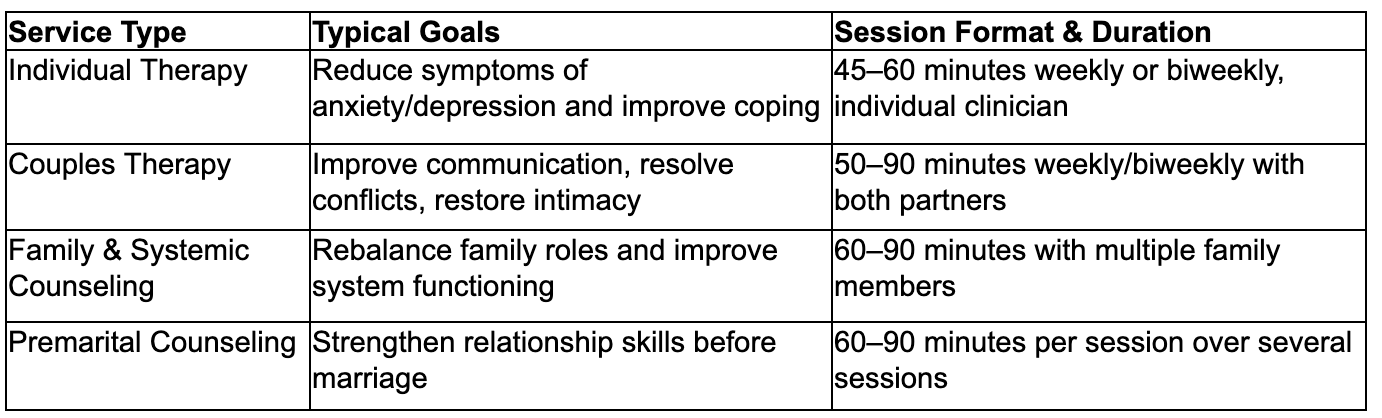
This table clarifies how each service aligns with common goals and practical session expectations, making it easier to select the right starting point for care.
The next subsection explains mechanisms by which couples therapy produces relational change and increased satisfaction.
How Does Couples Therapy Improve Communication and Relationship Satisfaction?
Couples therapy improves communication and relationship satisfaction by teaching concrete skills—such as active listening, structured turn-taking, and emotion regulation—that reduce misattunement and reactivity between partners. Therapists introduce behavioral exercises that pair skill practice with guided feedback to change interaction patterns, which in turn lowers conflict frequency and intensity. Research and clinical practice show that skill acquisition combined with emotional repair increases perceived closeness and stability; couples learn how to de-escalate arguments and rebuild trust through repeated corrective experiences. Practical outcomes include improved problem-solving, clearer expression of needs, and renewed intimacy, which set the stage for longer-term relationship resilience.
This mechanism-level explanation leads naturally to consideration of specialized options for couples who face identity-based stressors and cultural challenges.
What Specialized Counseling Options Exist for LGBTQ+ and Black Couples?
Specialized counseling for LGBTQ+ and Black couples adapts core relational interventions to address minority stress, identity-related trauma, and culturally specific family dynamics while preserving evidence-based techniques that improve communication and connection. Affirming therapists integrate sexual and gender identity competence, culturally informed narratives, and attention to external stigma into case conceptualization and interventions. For Black couples, clinicians may include culturally congruent psychoeducation about historical and community-level stressors and leverage culturally relevant strengths such as extended-family networks and faith-based resources. For LGBTQ+ couples, adaptations include addressing coming-out processes, chosen-family dynamics, and legal/healthcare stressors. Identifying a therapist with these competencies helps ensure therapy targets both relationship mechanics and the unique sociocultural contexts that shape partnership well-being.
Understanding specialized options points to how online therapy expands access to these modalities for geographically or logistically constrained clients.
How Can Online Therapy Services Provide Convenient and Affordable Mental Health Support?
Online therapy uses synchronous and asynchronous modalities—video, phone, text, and structured digital programs—to deliver evidence-based interventions that increase accessibility and often reduce cost barriers. By offering flexible scheduling, eliminating commute time, and expanding geographic reach, teletherapy platforms make it easier for people to find clinicians with specific competencies, including cultural and identity-affirming care. Research indicates online CBT and many structured couples interventions produce outcomes comparable to in-person care for mild-to-moderate conditions when platforms maintain rigorous clinical standards. However, online formats have limitations for crisis management or severe psychiatric instability and require careful attention to privacy, licensing, and platform features.
Before comparing modalities, here is a short overview of common online modalities and their ideal use-cases to guide selection.
Video Therapy: Best for real-time interaction and nonverbal cue work in individual and couples sessions.
Phone Therapy: Useful when video is not possible; preserves voice-based nuance and is accessible with limited bandwidth.
Text-Based Therapy: Provides ongoing asynchronous support and skill coaching, ideal for brief check-ins and skill reinforcement.
Structured Online Programs: Self-guided or clinician-supported courses effective for skill-building and psychoeducation.
These modality distinctions inform the comparative table below, which summarizes cost-related trade-offs, pros/cons, and best-use scenarios for online therapy options.
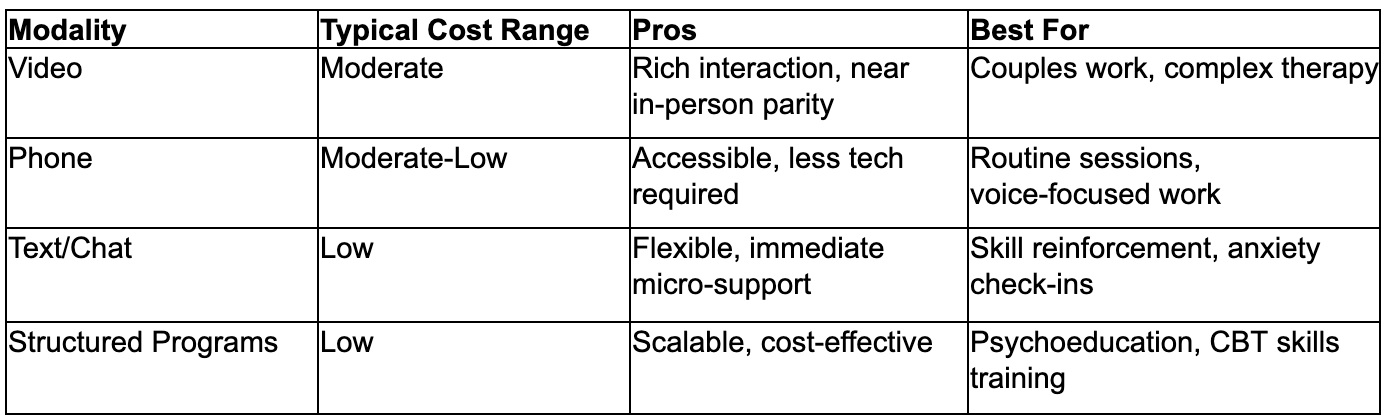
This comparison helps readers match modality to goals and constraints while keeping cost and clinical needs in balance.
The next subsection summarizes evidence and practical selection tips to help choose the right online therapist.
What Are the Benefits and Effectiveness of Online Counseling?
Online counseling delivers several key benefits: increased access to specialists regardless of location, flexible scheduling that fits work and family demands, and often lower per-session costs or subscription options that improve continuity of care. Current research shows structured online interventions—especially cognitive behavioral therapy delivered via video or guided programs—yield improvements comparable to in-person treatment for many common conditions like anxiety and depression. Limitations include less suitability for acute psychiatric crises, potential licensing constraints across state or national lines depending on local regulations, and the need for secure platforms to protect privacy. Evaluating a platform's clinical oversight, licensure policies, and emergency protocols helps determine whether online care will meet an individual's clinical needs.
How to Choose the Right Online Therapist for Your Needs?
Choosing the right online therapist begins with verifying credentials, specialization, and licensing status, then assessing match factors such as therapeutic approach, experience with specific populations, and communication preferences. A practical approach is to request a brief intake or consultation to evaluate fit, ask about experience with couples or culturally specific work, and confirm policies like cancellation, session length, and confidentiality. Red flags include vague treatment plans, lack of clear licensure information, and reluctance to discuss emergency protocols. Trial sessions can reveal whether the therapist’s interpersonal style and technical setup support productive work, and asking about measurement-based care—use of assessments to track progress—helps select clinicians committed to outcomes.
Choosing a good online therapist sets the stage for accessing affordable care options, which we discuss next along with sliding-scale and community resources.
Where Can You Find Affordable Mental Health Care and Sliding Scale Counseling Options?
Affordable care is available through several pathways—sliding-scale clinics, community mental health centers, university training clinics, non-profit organizations, and lower-cost online platforms—and each avenue balances cost, clinician experience, and accessibility in different ways. Understanding how sliding scales function, what documentation is typically requested, and where to look helps people find sustainable care. This section provides a practical list of search strategies, a concise EAV table comparing affordability options, and an explanation of how community services structure access to reduce financial barriers.
Below are practical search steps to locate low-cost or insurance-friendly therapists quickly.
Use directory filters for "sliding scale" or "low-cost" when searching online therapist directories.
Contact community mental health centers and non-profit counseling organizations to inquire about eligibility and waitlists.
Explore university training clinics and internship programs, which offer supervised care at reduced fees.
These steps clarify next actions; the table below summarizes common affordable care entities and how to approach them when seeking reduced-fee services.
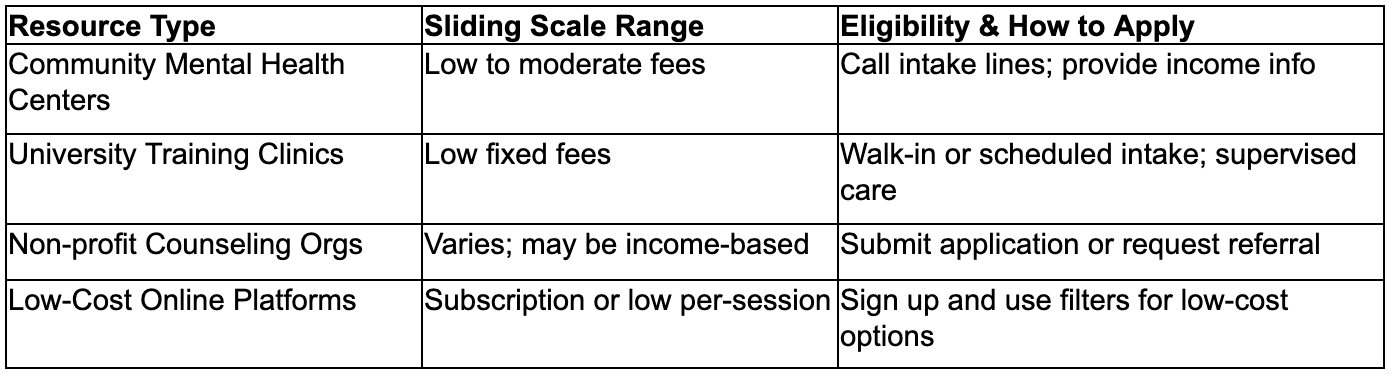
This table helps readers compare options quickly and choose the route that fits their budget and clinical needs.
The next subsection outlines specific directories and evaluation tips to refine the search.
What Resources Help Locate Low-Cost or Insurance-Friendly Therapists?
Several practical resources can speed the search for low-cost or insurance-friendly therapists, including therapist directories with sliding-scale filters, community health center listings, and university clinic pages with supervised services. When searching, use targeted keywords like "sliding scale counseling," "low-cost therapy," and "training clinic" combined with your location to narrow results, and prepare documentation such as proof of income if required. Compare options not only by price but by modality offered (in-person vs. teletherapy), wait times, and whether services are appropriate for couples work or specialized populations. Contacting intake staff directly to ask about typical fees, eligibility, and expected timeframes clarifies whether a given option is a practical match.
Exploring these resources naturally leads to understanding the role non-profit and community counseling services play in delivering care.
How Do Non-Profit and Community Counseling Services Support Mental Wellness?
Non-profit and community counseling services provide accessible entry points for therapy by offering sliding-scale fees, outreach programs, group therapy, and referrals to specialized providers, focusing on population-level needs and social determinants of health. Service models may combine brief individual therapy, psychoeducational groups, and case management that connects clients to housing, employment, or medical care as needed. Referral pathways often involve an initial intake assessment followed by allocation to individual clinicians, groups, or community workshops based on need and eligibility. The strengths of these services include local knowledge, cultural responsiveness in many programs, and partnerships with other social service agencies to address broader barriers to mental wellness.
Understanding affordability channels frames the next topic: how different therapeutic approaches produce clinical change.
What Are the Most Effective Therapeutic Approaches Used in Counseling?
Effective counseling draws from multiple modalities—Cognitive Behavioral Therapy (CBT), Emotion-Focused Therapy (EFT), the Gottman Method, EMDR, and psychodynamic approaches—each with distinct mechanisms and clinical targets. Selecting a modality depends on the presenting problem: CBT for anxiety and depression, EFT for attachment and emotion processing in couples, Gottman for structured relational skill-building, and EMDR for trauma processing. The following concise definitions with use-cases clarify when each approach is most appropriate and how practitioners often combine elements to address complex presentations.
Cognitive Behavioral Therapy (CBT): Targets the interaction between thoughts, behaviors, and emotions to reduce symptoms like anxiety and depression through skills training and exposure.
Emotion-Focused Therapy (EFT): Addresses attachment needs and emotional processing in couples to repair ruptures and strengthen bonding.
Gottman Method: Uses assessment-driven interventions to improve communication, reduce destructive patterns, and build relationship skills.
EMDR (Eye Movement Desensitization and Reprocessing): Processes traumatic memories with bilateral stimulation to reduce trauma-related distress.
These modality summaries prepare readers for a deeper look at how CBT works for mood disorders and how the Gottman Method functions in couples care.
How Does Cognitive Behavioral Therapy Address Anxiety and Depression?
CBT addresses anxiety and depression by identifying and restructuring unhelpful thought patterns, increasing engagement in reinforcing activities, and using behavioral experiments and exposure to reduce avoidance and fear. Sessions typically follow a structured format—agenda setting, symptom measurement, skill practice, and homework—to build capacity for emotion regulation and cognitive flexibility over weeks to months. Evidence supports CBT’s effectiveness across a range of severity levels, with measurable symptom reduction often apparent within 8–16 weekly sessions when clients practice skills between sessions. When symptoms are complex or treatment response is partial, clinicians may integrate adjunctive approaches such as pharmacotherapy coordination or trauma-focused modalities.
What Role Does the Gottman Method Play in Couples and Marriage Counseling?
The Gottman Method plays a prominent role in couples counseling by combining assessment-driven interventions, concrete communication tools, and research-based exercises aimed at improving trust, friendship, and conflict management. Core concepts like the Four Horsemen, the Sound Relationship House, and structured communication exercises guide therapists in diagnosing interaction patterns and prescribing targeted interventions to replace destructive cycles with positive routines. The method emphasizes measurement-based practice—using questionnaires and observational data—to track progress and tailor interventions, which supports measurable gains in relationship satisfaction when applied consistently. For couples seeking a structured, skills-oriented path to repair and growth, the Gottman Method offers a practical roadmap with a strong empirical foundation.
*Investigating the effect of couple-centered counseling by Gottman method, 2020.
Infertility represents one of the most distressing experiences for couples navigating its challenges. Consequently, managing the associated psychological burden has become a significant concern across many societies due to its detrimental effects on couples' lives and levels of intimacy.
A deficit in marital intimacy can result in adverse outcomes, including dissatisfaction within marital relationships. Therefore, individuals facing infertility should be encouraged to seek effective coping strategies.
Given the critical role of the emotional connection between infertile couples and the success rates of infertility treatments, this study investigates the impact of Gottman Method couples-centered counseling on the marital intimacy of infertile couples referred to the infertility clinic at Fatemieh Hospital in Hamadan.
*Investigating the effect of couple-centered counseling by Gottman method on the intimacy of infertile couples referring to the infertility Ward of Fatemieh hospital …, SZ Masoumi, 2022
With treatment approaches outlined, the next sections help readers find culturally competent counselors for diverse relationship needs.
How Do You Find Culturally Competent Counselors for Diverse Relationship Needs?
Finding culturally competent counselors involves assessing clinicians for demonstrated experience, inclusive language, and specific training or supervision in working with LGBTQ+ and Black couples, plus evaluating whether their practice environment supports confidentiality and affirmation. A focused checklist helps identify therapists who combine clinical competence with cultural humility and community awareness. Using specialized directories, community referrals, and targeted search terms increases the likelihood of matching with clinicians who understand minority stressors, intersectionality, and culturally specific relational strengths.
This guidance leads into detailed indicators for LGBTQ+ affirming practice and culturally adapted approaches for Black couples, as offered by affirmative therapy practitioners (including our therapists at NYC Affirmative Psychotherapy).
Look for explicit statements of affirming practice and non-discrimination on clinician profiles.
Ask about training, supervision, or clinical experience working with specific communities.
Request examples of culturally adapted interventions or how identity-related stressors are incorporated into treatment plans.
This checklist prepares readers to ask pointed intake questions and to evaluate fit during the initial sessions, as elaborated in the next subsections.
What Should You Look for in LGBTQ+ Affirming Therapists?
LGBTQ+ affirming therapists demonstrate competence through inclusive language, knowledge of queer-specific relationship dynamics, and experience addressing minority stress, identity development, and chosen-family complexities. During intake, ask about experience with sexual and gender diversity, use of affirming frameworks, and how confidentiality is handled for sensitive identity concerns. Certification or affiliations with LGBTQ+ professional networks can be helpful indicators, though concrete case examples and client-centered approaches are more telling than titles alone. A safe and affirming therapeutic relationship prioritizes clients’ self-defined identities and integrates structural context—such as discrimination or legal concerns—into treatment planning to support resilience and relational health.
(Read more about our approach to affirmative therapy.)
Culturally Competent Strategies for LGBTQ+ Couple and Family Therapy
This chapter examines intercultural considerations within LGBTQ+ couple and family therapy, underscoring the necessity for culturally responsive strategies that are both appropriate and efficacious for diverse LGBTQ+ clientele. It prioritizes the promotion of empowerment and resilience at the intersection of identities in therapeutic practice.*
*Intercultural issues in LGBTQ+ couple and family therapy: Supporting empowerment and resilience at the intersection of identities, 2021
These indicators connect directly to culturally informed practices useful when working with Black couples, discussed next.
How Does Black Marriage Counseling Address Unique Cultural and Relational Challenges?
Black marriage counseling intentionally addresses historical, social, and identity-linked stressors—such as systemic racism, intergenerational trauma, and culturally specific family expectations—while leveraging cultural strengths like community networks, resilience narratives, and faith-based supports. Clinicians who work effectively with Black couples incorporate cultural competence into assessment and intervention, using culturally relevant communication styles and acknowledging external pressures that shape relationship dynamics. Therapeutic goals may include navigating cultural expectations, repairing attachment injuries exacerbated by external stressors, and building strategies to maintain intimacy amid external strain. Community resources and culturally informed psychoeducation often complement individual and couples interventions to foster sustainable relational wellbeing.
Recognizing culturally competent care’s impact leads into the final major section describing counseling benefits for mental health and relationships.
What Are the Key Benefits of Counseling for Mental Health and Relationship Wellness?
Counseling delivers quantifiable benefits for mental health—reducing symptoms of anxiety, depression, and trauma—and for relationships by improving communication, problem solving, and emotional intimacy through targeted interventions and measurable skill acquisition. Short-term gains include symptom relief and improved coping strategies; long-term benefits involve sustained relationship maintenance, increased resilience to stress, and prevention of relapse when follow-up and booster sessions are used. Evidence-based therapies produce reliable effect sizes across conditions when matched to clinical needs and when progress is tracked with standardized measures. The next subsections detail how counseling addresses specific mental health conditions and illustrate outcomes of long-term relationship work.
The clinical mechanisms used in therapy map directly onto symptom reduction and improved day-to-day functioning, which we discuss with concrete strategies for common conditions.
How Does Counseling Help Manage Anxiety, Depression, and Trauma?
Counseling manages anxiety, depression, and trauma by combining symptom-targeted strategies—such as cognitive restructuring, behavioral activation, exposure, and trauma processing—with stabilization skills like grounding and emotion regulation. Treatment plans typically include measurable goals, homework assignments to generalize skills, and periodic outcome measures to track symptom change. For trauma, trauma-informed care and modalities like EMDR or prolonged exposure focus on memory processing and integration, while depression often responds to behavioral activation and CBT strategies that increase rewarding activity and shift unhelpful thinking. Progress is assessed through symptom scales and functional markers such as return to work, improved sleep, and restored social engagement, guiding decisions about step-up care when needed.
What Positive Outcomes Result from Long-Term Relationship Counseling?
Long-term relationship counseling yields outcomes including improved conflict resolution skills, enhanced emotional intimacy, stronger friendship and trust, and greater resilience to life stressors, all of which contribute to relationship stability and satisfaction over time. Sustained therapy helps partners internalize communication routines, practice repair after ruptures, and develop shared meaning and goals that buffer against future conflicts. Maintenance strategies—such as periodic check-ins, relationship rituals, and skill refresher sessions—help preserve gains after formal therapy ends. Typical timelines for noticeable change vary, but many couples see meaningful improvements in communication and conflict management within a few months, with deeper shifts in attachment and intimacy emerging over longer-term work.
We hope this guide helps readers choose, access, and evaluate counseling services that match their mental health and relational goals.
Written by Aaron Skinner-Spain, LCSW-R
Executive Director, NYC Affirmative Psychotherapy
Pronouns: He/Him
Education: A.B., Cornell University; M.S.W., New York University
Training: Covenant House New York-Mother and Child Program; SCO Family of Services-GLBTQ Program; SCO Family of Services East New York-High School Suspension Program; New York University Counseling and Wellness Services; Training Institute for Mental Health; Trauma Research Foundation; Parnell Institute
License: New York State #080690
Post-Graduate Training and Certifications: Executive Healthcare Leadership, Cornell University; Supervisory Training Program, Training Institute for Mental Health; Four-Year Program, Psychoanalysis, Training Institute for Mental Health; Seminar in Field Instruction (SIFI), Fordham University; Undoing Racism Workshop; The People’s Institute for Survival and Beyond
Area(s) of Expertise: college mental health, depression, anxiety, panic attacks, LGBTQ affirmative therapy, childhood trauma, acute trauma, racial trauma and stress, coping skills, AF-EMDR, clinical supervision for therapists, entrepreneur, and executive stress