
Find Counseling Services That Fit Your Budget
Counseling Services Near Me: How to Find the Right Therapy for Your Needs
Finding the right counseling services near me means matching your problem, preferred delivery mode, and budget to the therapy type that will deliver measurable results. This guide explains what counseling services are, how different modalities work, and practical steps for locating affordable, secure, and effective care for common concerns such as anxiety, depression, relationship conflict, trauma, and adolescent challenges. Many people searching for "couples therapy for communication," "sliding scale mental health services," or "virtual therapy platforms" need clear, actionable comparisons rather than general directories, and this article supplies those comparisons. You will learn which therapy types fit which conditions, how online counseling works and when to use it, what to expect for anxiety, depression and trauma treatment, how family therapy helps blended households and teens, and how to navigate costs and confidentiality. The sections include quick comparison tables, concise checklists, and practical next steps designed to speed your search and improve the odds of a good therapeutic match.
Read on for a stepwise approach to mapping symptoms → modality → expected outcomes so you can find local or virtual counseling services that actually meet your needs.
What Types of Counseling Services Are Available?
Counseling services encompass several distinct modalities—individual, couples, family, adolescent, group, and specialized therapies—each designed to address different problems through targeted mechanisms. Individual therapy focuses on personal symptom reduction and skill-building, couples therapy targets relationship patterns and communication, and family therapy attends to systemic interactions within a household. Choosing the right type matters because the mechanism of change differs: cognitive behavioral techniques teach skills to change thinking and behavior, EMDR targets traumatic memory processing, and EFT repairs emotional bonding in relationships. Below is a compact comparison to help you match core therapy types to common goals, benefits, and a typical session count range.
Different therapy modalities suit different problems and timelines.
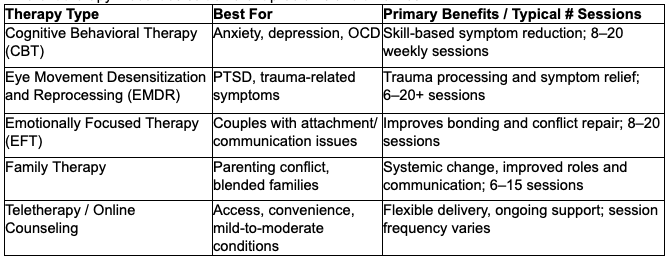
This table clarifies how each modality maps to common needs and expected timelines. Understanding these distinctions makes it easier to search for specialized providers and to set realistic expectations for progress.
Counseling services also vary by specialization and setting, and understanding those options helps you narrow "near me" searches to providers who treat your issue effectively. The next subsections explain individual therapy and couples therapy in practical terms so you can quickly identify which path to pursue.
What Is Individual Therapy and How Can It Help Mental Wellness?
Individual therapy is one-on-one treatment between a client and a trained therapist that focuses on symptom reduction, self-exploration, and building coping skills through evidence-based methods. The mechanism is direct: therapist and client identify problem patterns, apply interventions such as cognitive restructuring or behavioral experiments, and measure outcomes via symptom tracking and goal-setting. For anxiety, CBT and exposure work to reduce avoidance and reframe catastrophic thinking; for depression, behavioral activation increases activity to counter anhedonia. Expect an intake session for assessment, a collaboratively developed treatment plan, and ongoing progress reviews, with many brief therapies delivering meaningful change in 8–20 sessions.
Individual therapy commonly integrates related resources such as psychiatric consultation for medication, prescription digital therapeutics for structured behavioral programs, and peer support groups when ongoing community reinforcement is helpful.
How Does Couples Therapy Improve Relationship Communication?
Couples therapy focuses on interactional patterns between partners and uses modalities such as Emotionally Focused Therapy (EFT), Gottman-informed techniques, and communication skills training to rebuild trust and improve problem-solving. The mechanism centers on identifying negative cycles, increasing emotional accessibility, and teaching practical skills like reflective listening, time-limited check-ins, and repair attempts after conflict. Typical outcomes include improved conflict resolution, clearer boundaries, and increased relational safety, often measurable by reduced arguments and increased intimacy within 8–20 sessions. Couples often seek therapy when communication breakdowns persist, infidelity or trust concerns arise, or when preparing for major transitions like marriage or parenting, and timely intervention tends to prevent escalation.
Therapists may combine couples work with individual therapy or referrals to specialized trauma treatment when infidelity or unresolved trauma underpins relationship problems.
How Do Online Counseling Services Work and What Are Their Benefits?
Online counseling services deliver therapy via video, phone, or secure messaging so clients can access licensed therapists without travel, increasing convenience and continuity of care. The mechanism relies on encrypted platforms and clinical workflows adapted for telehealth: intake and informed consent occur remotely, therapists conduct assessments via standardized measures, and sessions follow structured agendas similar to in-person care. Benefits include broader provider choice, easier scheduling, and often faster access to specialty care such as trauma-focused clinicians or niche populations like LGBTQ+ youth. Teletherapy also enables hybrid care models where in-person and virtual sessions alternate to match treatment goals and life constraints.
Below is a concise comparison of delivery modes to clarify features and practical expectations for privacy and cost.
Online delivery modes vary in features, privacy safeguards, and typical costs.
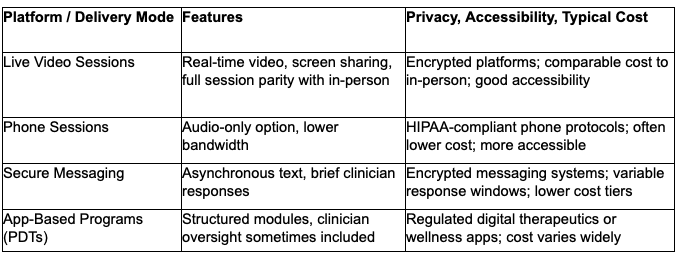
This table helps set expectations about what each delivery mode provides and how it balances privacy, convenience, and cost.
Practical benefits and limitations of online counseling include quick access to specialists, reduced travel barriers for rural users, and flexibility for caregivers; limitations include licensing constraints across state lines and potential technology reliability issues. The next subsections explain session expectations and how to choose a qualified online therapist.
What Should You Expect During a Virtual Therapy Session?
A typical virtual therapy session begins with a remote intake that covers presenting problems, safety planning, informed consent, and technical checks to ensure secure connection, with the therapist clarifying confidentiality limits and emergency protocols. Sessions then proceed with agenda-setting, therapeutic interventions—such as cognitive restructuring, emotion-focused interventions, or behavioral activation—and collaborative homework or between-session tasks to reinforce skills.
Therapists often use standardized outcome measures to track symptom change over time and will plan follow-up or referrals as needed for medication or intensive services. Clients should create a private, distraction-free space, test their connection in advance, and confirm how to reach emergency services if a crisis arises during a remote session.
Understanding session flow and safety planning reduces anxiety about teletherapy and improves engagement, which in turn speeds therapeutic progress.
How to Choose a Qualified Online Therapist for Your Needs?
Choosing a qualified online therapist involves verifying credentials and licensure, confirming specialization relevant to your condition (e.g., PTSD, teen mental health, couples therapy), reviewing evidence of trauma-informed training, and checking patient reviews or platform reputation where available. Important practical questions include whether the therapist is licensed in your state, how they handle confidentiality and record-keeping, their cancellation and no-show policies, and whether they coordinate care with prescribers when medication is part of the plan. Red flags include vague credentials, refusal to share licensure information, or insistence on unproven methods without evidence. A short intake call to assess fit, rapport, and practical logistics often yields the best indicator of likely therapeutic success. You can submit your intake form to NYC Affirmative Psychotherapy online by filling out their New Client Questionnaire.
A careful selection process increases the probability of a good therapeutic alliance, which is one of the strongest predictors of positive outcomes across modalities.
What Are the Most Common Mental Health Conditions Treated by Counseling?
Counseling services commonly treat anxiety disorders, depressive disorders, trauma-related conditions, obsessive-compulsive and related disorders, ADHD, and substance-related concerns, with each condition responding best to specific evidence-based modalities. The mechanism for change varies: CBT and exposure reduce anxiety by retraining responses, behavioral activation addresses depressive inertia by increasing rewarding activities, and trauma therapies like EMDR or trauma-focused CBT reprocess distressing memories. Therapy often works in combination with psychiatric medication when symptoms are severe or when biological factors play a significant role. Below are focused explanations for anxiety and for depression/trauma, showing typical therapeutic pathways and immediate coping strategies.
Targeting conditions to modalities and expected outcomes helps you find a provider who can offer evidence-based care and clear progress markers.
How Is Anxiety Managed Through Therapy?
Anxiety is typically managed through cognitive behavioral therapy (CBT) and exposure-based techniques that change avoidant behaviors, challenge catastrophic thinking, and teach physiological regulation skills. The mechanism involves repeated, graduated exposure to feared stimuli paired with cognitive restructuring to weaken anxiety associations and strengthen tolerance, while mindfulness and breathing techniques reduce immediate physiological arousal. Practical takeaways include practicing brief grounding exercises during panic, scheduling behavioral experiments to test feared outcomes, and using structured worry time to contain rumination. When anxiety is severe or linked to neurobiological factors, combining therapy with medication or specialized programs such as prescription digital therapeutics can improve outcomes.
These methods produce measurable change within weeks for many clients, and therapists typically use standardized anxiety scales to track progress and adjust treatment accordingly.
What Therapy Options Are Effective for Depression and Trauma?
Depression commonly responds to CBT and behavioral activation, which address negative thinking and low behavioral engagement, while trauma benefits from EMDR and trauma-focused CBT that safely process traumatic memories and reduce hyperarousal. The mechanism for depression treatment emphasizes reintroducing reinforcement and restructuring maladaptive beliefs, and for trauma treatment it centers on memory reconsolidation and desensitization to trauma cues. Typical timelines vary: brief depression treatments may show benefits in 8–12 sessions whereas complex trauma often requires longer-term work plus careful stabilization. When depressive or traumatic symptoms severely impair functioning or include suicidality, coordinated psychiatric evaluation for medication and safety planning is essential.
Choosing an approach that matches symptom profile and trauma history leads to more predictable improvement and clearer goal-setting between client and clinician.
How Can Family Therapy Support Different Family Dynamics?
Family therapy treats the family as a system where change in one part affects the whole; it applies interventions to patterns, roles, and communication to improve functioning across configurations like blended families, single-parent homes, and multi-generational households. The mechanism is systemic: therapists map interaction patterns, coach alternate responses, and realign expectations so that conflict decreases and adaptive routines emerge. Family therapy is especially helpful during life transitions—divorce, remarriage, blending households, chronic illness—and when parenting strategies conflict. The following subsections detail adolescent counseling and blended-family strategies so you can see where family-level interventions intersect with individual and relational work.
Systemic change through family therapy creates durable improvements because it shifts the environment that maintains problematic behaviors.
What Are the Benefits of Adolescent and Teen Counseling?
Adolescent counseling focuses on developmental tasks—identity formation, peer relations, emerging autonomy—and treats issues like mood disorders, behavioral problems, school difficulties, and identity concerns with age-appropriate techniques and family involvement. Therapists combine individual sessions that build coping skills and emotional regulation with family sessions that improve communication and align parental responses. Signs to seek help include sudden academic decline, withdrawal, self-harm risk, substance use, or persistent mood changes. Involvement of caregivers is tailored to the teen's developmental stage; clinicians balance confidentiality with safety and parental engagement to support progress.
Early intervention for teens reduces escalation and supports better academic, social, and emotional outcomes as adolescents transition to adulthood.
How Does Family Counseling Address Parenting and Blended Family Challenges?
Family counseling for parenting and blended families focuses on aligning parenting styles, establishing consistent routines, and negotiating stepfamily roles to reduce conflict and build cohesion. Therapists use role clarification exercises, co-parenting agreements, and joint problem-solving to create shared expectations and to reduce triangulation between family members. Practical strategies include establishing neutral family rituals, defining discipline boundaries, and scheduling dedicated one-on-one time to build attachment across step relationships. Progress is often measurable by improved cooperation, reduced incidents of escalation, and clearer routines that support children's emotional security.
Addressing these dynamics early and systematically prevents entrenched patterns that otherwise undermine family resilience and individual well-being.
What Affordable Therapy Options Are Available and How Does Insurance Work?
Access to counseling depends heavily on cost models—sliding scale services, community clinics, university training clinics, teletherapy platforms, and in-network insurance plans each offer different trade-offs between cost and provider experience. The mechanism for affordability often hinges on subsidy, training models, or platform pricing; sliding scales adjust fees based on income, community clinics receive funding to provide reduced-cost care, and university clinics offer low-cost sessions under supervision. Below is a concise comparison of payment options and how to access them so you can quickly triage where to start your search.
Understanding payment options helps you choose between fewer-cost sessions with trainees and higher-cost care with experienced specialists depending on urgency and complexity.
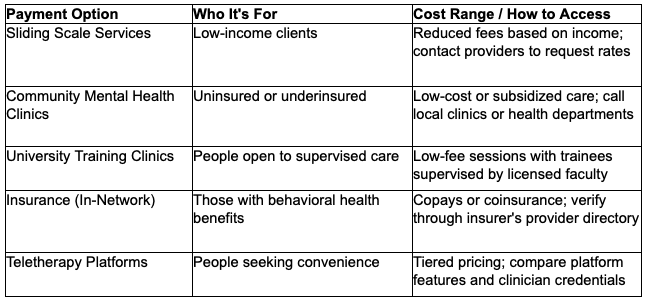
This table simplifies where to look first depending on budget and urgency, and shows typical access routes.
Practical steps to verify insurance and find low-cost care include checking in-network provider lists, asking about sliding scale policies during intake, and using teletherapy or university clinics for faster lower-cost access. The next subsections describe sliding scale resources and how insurance terms affect access.
What Are Sliding Scale Services and Low-Cost Therapy Resources?
Sliding scale services reduce fees according to income or financial need, making licensed care accessible to clients who would otherwise be unable to pay full rates, and often require brief documentation or an eligibility conversation. Common low-cost resources include community mental health centers, university training clinics where graduate students provide supervised care, nonprofit organizations offering pro bono or low-fee counseling, and teletherapy platforms with lower-cost tiers. To access these resources, inquire directly with local clinics about income-based rates, explore community mental health listings, and ask about waitlists or group therapy options that lower per-session cost. Many providers will discuss payment options during an initial consult, and being transparent about financial constraints often opens alternative pathways to care. (Click for more info on NYCAP’s sliding scale services.)
These resources provide practical, affordable entry points to therapy while preserving quality through supervision, group formats, or public funding.
How Does Insurance Coverage Affect Access to Counseling Services?
Insurance affects access through network restrictions, deductibles, copays, authorization requirements, and parity laws that vary by plan and jurisdiction, with in-network providers generally producing lower out-of-pocket costs than out-of-network clinicians. The steps to verify coverage include locating your insurer's behavioral health provider directory, checking whether a preferred therapist is in-network, asking about session limits or preauthorization, and confirming billing codes for mental health visits to determine reimbursement. If coverage is limited, alternatives include using a health savings account, seeking sliding scale services, or requesting superbills from out-of-network providers for partial reimbursement. Understanding these terms ahead of time prevents unexpected bills and helps you plan for sustained care.
A short verification checklist makes insurance navigation faster and reduces administrative barriers to beginning therapy.
What Should You Know About Confidentiality and the Counseling Process?
Confidentiality in counseling means clinicians protect client information through secure record-keeping, informed consent, and adherence to legal standards, while recognizing limits such as mandated reporting for child abuse, threats of harm to self or others, and court-ordered disclosures. Therapists typically explain confidentiality practices during intake and obtain written informed consent that outlines record retention, information sharing, and how billing may affect privacy. Secure practices include encrypted notes, HIPAA-compliant platforms for teletherapy, and restricted access to electronic health records. Clear understanding of these protections and limits builds trust and helps clients participate openly, which increases the effectiveness of therapy.
Knowing how privacy is maintained also helps clients make informed choices when selecting in-person vs. virtual services and when deciding what to disclose in early sessions.
How Is Client Privacy Maintained in Therapy Sessions?
Client privacy is maintained through multiple safeguards including encrypted telehealth platforms, confidential progress notes stored in secure systems, strict access controls within practices, and informed consent processes that define who can access records. Therapists explain exceptions to confidentiality, such as mandated reporting of abuse, imminent risk of harm, or legal subpoenas, and they document consent for any information-sharing with third parties. Clients have rights to request copies of records or to limit disclosures in many jurisdictions, and asking therapists about their specific privacy practices is an appropriate step during intake. Clarifying these protocols reduces anxiety about data handling and ensures clients can make informed decisions about modality and disclosure.
Asking specific questions about platform encryption, record retention, and billing privacy during an initial consult helps confirm that a provider's practices meet your expectations.
How Long Does Therapy Typically Take to Show Results?
Therapy timelines vary by condition and modality: brief, problem-focused CBT often produces measurable improvement in 6-12 sessions for many anxiety and mood disorders, exposure-based plans can yield fast reductions in avoidance, while complex trauma or longstanding personality patterns may require months to years of work. Therapists set measurable goals and use standardized outcome tools to track progress, adjusting interventions when improvement stalls or when new concerns emerge. Factors that influence speed include symptom severity, comorbid conditions, client engagement with between-session tasks, and the fit between therapist approach and client needs. Regular progress reviews and collaborative goal-setting help clients and therapists evaluate when to continue, modify, or augment treatment with medication or more intensive services.
Understanding typical timelines helps set realistic expectations and supports sustained engagement in the therapeutic process.
Ask about measurable goals: Request symptom scales and regular reviews to track progress.
Consider combined care: When progress is limited, coordinate with psychiatry or specialty services.
Prioritize therapeutic fit: Strong alliance and matched modality speed outcomes and improve retention.
Start by clarifying the problem: Accurate problem definition guides modality choice and expected timeline.
Follow through with homework: Active practice outside sessions amplifies treatment effects.
Reassess if progress stalls: Timely adjustments prevent wasted sessions and improve outcomes.
Each of these practical actions increases the likelihood that counseling services deliver meaningful, timely benefit.
Written by Aaron Skinner-Spain, LCSW-R
Executive Director, NYC Affirmative Psychotherapy
Pronouns: He/Him
Education: A.B., Cornell University; M.S.W., New York University
Training: Covenant House New York-Mother and Child Program; SCO Family of Services-GLBTQ Program; SCO Family of Services East New York-High School Suspension Program; New York University Counseling and Wellness Services; Training Institute for Mental Health; Trauma Research Foundation; Parnell Institute
License: New York State #080690
Post-Graduate Training and Certifications: Executive Healthcare Leadership, Cornell University; Supervisory Training Program, Training Institute for Mental Health; Four-Year Program, Psychoanalysis, Training Institute for Mental Health; Seminar in Field Instruction (SIFI), Fordham University; Undoing Racism Workshop; The People’s Institute for Survival and Beyond
Area(s) of Expertise: college mental health, depression, anxiety, panic attacks, LGBTQ affirmative therapy, childhood trauma, acute trauma, racial trauma and stress, coping skills, AF-EMDR, clinical supervision for therapists, entrepreneur, and executive stress