
Expert Counseling in NYC - Find Support Today
Comprehensive Counseling NYC: Find Affordable Individual, Couples, and LGBTQ+ Therapy Online
Finding counseling in NYC means navigating a wide range of mental health services across boroughs, modalities, and payment options to get timely, effective support. This guide explains what "counseling in NYC" includes, how services work (in-person and telehealth), and the specific benefits clients can expect when they pursue evidence-based care. Many New Yorkers face stress, relationship conflict, anxiety, and trauma; this article offers clear pathways for choosing services, accessing online care, and using insurance or sliding-scale fees to make therapy affordable. You will learn how to compare service types, start teletherapy safely, verify insurance benefits step-by-step, and find culturally competent and LGBTQ+ affirming clinicians. The article is organized around service types, online access, affordability and insurance, specialized community care, therapist selection, and common clinical issues so you can move from understanding to action quickly.
What Types of Counseling Services Are Available in NYC?
Counseling services in NYC encompass a range of modalities designed for specific needs, including individual, couples, marriage, family, group, and online therapy; each offering distinct mechanisms and outcomes that improve functioning and relationships. Individual therapy addresses intrapersonal patterns through evidence-based approaches like CBT or trauma-focused work, while couples and marriage counseling target relational dynamics using approaches such as EFT or behavioral methods. Group therapy provides peer-supported learning and social skills practice, and family therapy shifts systemic interaction patterns to reduce conflict and improve communication. Understanding these service types helps people match problems to treatments and set realistic expectations for outcomes, which leads naturally into a closer look at how individual therapy supports mental health.
Individual therapy in NYC helps people identify patterns and build coping strategies through assessments, a personalized treatment plan, and regular sessions that apply therapeutic techniques to real-life problems. Therapists typically use evidence-based methods -- such as CBT for anxiety and depression, psychodynamic approaches for long-standing relational patterns, and trauma-informed care like EMDR for PTSD -- to change thinking, behavior, and physiological responses. Outcomes often include reduced symptoms, improved functioning at work or school, and stronger emotion regulation, though timelines vary by issue severity and treatment intensity. If individual work uncovers relational issues or attachment patterns, couples or family therapy may be recommended next to address interpersonal dynamics.
How Does Individual Therapy in NYC Help with Mental Health?
Individual therapy reduces distress by identifying maladaptive thoughts and behaviors, applying targeted interventions, and reinforcing adaptive skills through practice and feedback. The mechanism commonly involves cognitive restructuring, exposure or behavioral activation, and skill-building that directly alters emotional responses and daily functioning. Clients typically set measurable goals -- such as reducing panic attacks, improving mood, or managing stress -- and track progress over sessions, which promotes accountability and refinement of strategies. Understanding the individual therapy process clarifies when couples or family work may be a more appropriate next step for relationship-focused challenges.
What Are the Benefits of Couples and Marriage Counseling in NYC?
Couples and marriage counseling addresses relationship problems by improving communication patterns, repairing trust after infidelity, and helping partners navigate parenting or life transitions through structured interventions. Approaches such as Emotionally Focused Therapy (EFT) target attachment and emotional responsiveness, while integrative behavioral couples therapy focuses on behavior change and problem-solving; both methods aim to increase relational satisfaction and stability. Expected benefits include clearer conflict resolution strategies, restored intimacy, and a shared toolkit for managing future stressors, although success depends on mutual engagement and consistent practice outside sessions. When partners face safety concerns or substance use, specialized adjunct services or referrals, including psychiatric consultation, may be necessary before or during couples work.
Different counseling services in NYC can be compared quickly by use-case to help readers choose the most relevant option.
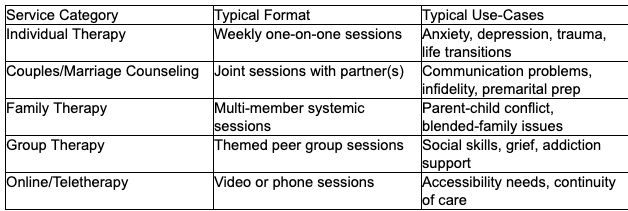
This table clarifies service selection by matching format to common presenting problems and helps readers decide which pathway to explore first.
How Can You Access Online Therapy Services in NYC?
Online therapy in NYC gives residents access to licensed clinicians via secure telehealth platforms, maintaining therapeutic mechanisms -- assessment, treatment planning, and intervention -- while removing geographic barriers and improving scheduling flexibility. To access online care, search for clinicians licensed to treat clients in New York, confirm their telehealth offerings, and verify privacy and technology standards; the clinician’s licensure and clinical approach determine whether teletherapy is clinically appropriate. Online therapy can be equally effective as in-person care for many conditions when best practices for telehealth are followed, including establishing safety plans and ensuring confidentiality. Below are practical steps to begin online therapy safely and efficiently.
Search for clinicians licensed in New York: Confirm state licensure and professional credentials.
Verify telehealth capability: Ask about video platform security and backup plans for connectivity issues.
Confirm treatment approach: Ensure the therapist uses evidence-based modalities suited to your needs.
Schedule an initial consultation: Use intake calls to assess rapport, availability, and fees.
These steps simplify the process of beginning teletherapy; once you complete intake, you can focus on treatment goals and session continuity.
What Are the Advantages of Online Individual and Couples Therapy?
Online individual and couples therapy increases access by reducing travel time, expanding the pool of specialists across boroughs, and enabling flexible scheduling that fits busy NYC lives. Mechanistically, teletherapy preserves therapeutic alliance and intervention strategies -- like cognitive restructuring and attachment-focused work -- when clinicians adapt practices for virtual delivery and maintain clear communication protocols. Research from recent years indicates comparable outcomes for many conditions when teletherapy follows best practices, especially for anxiety, depression, and relational therapy that focuses on communication. When technology, privacy, and safety checks are in place, online options can be the primary pathway for many clients and a bridge to in-person care when needed.
How Affordable Is Online Therapy Compared to In-Person Sessions in NYC?
Online therapy in NYC is often 10–20% less expensive than in-person sessions due to lower overhead and the ability of some providers to offer flexible formats, though price ranges vary widely by clinician credentials and specialization. Sliding-scale fees and community programs further reduce costs for clients with financial need, and insurance coverage mechanisms apply similarly to telehealth when services meet medical necessity criteria. In-person sessions may still be preferable for complex trauma or when clinicians require observation of nonverbal cues in a controlled setting, but teletherapy often increases affordability and continuity of care for many people. Understanding these cost dynamics helps clients weigh convenience against the clinical requirements of their presenting issues.
How Do You Find Affordable Therapy and Use Insurance in NYC?
Finding affordable therapy in NYC requires understanding in-network versus out-of-network coverage, how sliding-scale fees work, and what low-cost resources like city mental health hotlines offer. Insurance plans typically cover medically necessary mental health services, but verification steps -- checking provider networks, session limits, copays, and prior authorization requirements -- are essential before beginning care. Sliding-scale fees adjust rates based on income and household size and are offered by many community clinics and some private clinicians, widening access for lower-income clients. Below is a practical checklist to verify benefits and a comparison table describing payment options and typical expectations for NYC clients.
Confirm in-network status: Call your plan or check provider directories to see if a clinician is in-network.
Ask about session limits and copays: Clarify annual limits, frequency allowances, and out-of-pocket costs.
Document necessary codes: Request billing CPT codes and a superbill for out-of-network reimbursement if needed.
Check telehealth coverage: Verify whether teletherapy sessions are covered at the same rate as in-person visits.
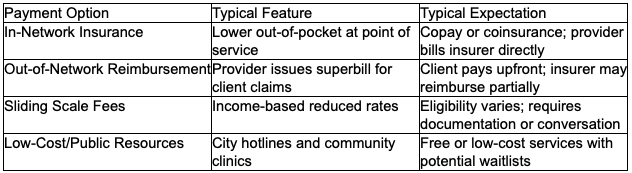
This table clarifies trade-offs between convenience, cost, and administrative steps for different payment pathways and helps readers prioritize options based on affordability and urgency.
What Insurance Plans Cover Counseling Services in NYC?
Most major insurance plans include mental health benefits that cover medically necessary counseling, but coverage details differ by plan type and network; confirming specifics prevents billing surprises. To verify coverage, gather your insurer and plan name, ask about in-network providers with relevant credentials (LCSW, LMHC, LMFT, psychologist), verify session limits, and request information on prior authorization or medical necessity criteria. If a preferred clinician is out-of-network, inquire about superbills and typical reimbursement rates, and document all communications and claim forms for potential appeals. These verification steps lead naturally into understanding how sliding-scale models can complement insurance to improve affordability.
Affirming LGBTQ+ Therapy for Minority Stress
This section outlines the application of a process-based, contextual behavior therapy as a model for affirming and supporting LGBTQ+ clients experiencing minority stress. Minority stress arises from societal bias, manifesting as harm inflicted upon LGBTQ+ individuals through the actions of politicians, media misrepresentations, societal movements, or rejection by loved ones and family. These external factors shape and impact the internal and external behaviors of LGBTQ+ individuals, perpetuating instances of harm. Such therapeutic interventions can alleviate suffering associated with painful histories, foster resilience and well-being, and encourage more vulnerable and meaningful relationships. Process-based, affirming, contextual behavior therapies offer a viable approach to addressing the harms of minority stress and identifying valued pathways toward a more equitable world.
*Affirming Therapy in Response to Minority Stress Among LGBTQ+ Clients, MD Skinta, 2025
How Do Sliding Scale Fees Make Therapy More Accessible in NYC?
Sliding-scale fees adjust the clinician’s standard rate based on a client’s income or financial circumstances, typically offering a reduced per-session fee and sometimes requiring simple verification like pay stubs or a brief intake discussion. Community clinics, training clinics, and some private practitioners offer sliding scales to expand access, and eligibility criteria vary; asking about availability during initial outreach is standard practice. Requesting a sliding scale can be framed as a routine administrative conversation -- describe your situation and ask what documentation they need -- so clinicians can determine an appropriate reduction. Sliding-scale options, combined with public resources like city mental health lines, create multiple pathways to care when standard fees or insurance coverage are limiting.
What Specialized Therapy Options Are Available for Diverse NYC Communities?
NYC’s diverse population benefits from specialized therapy options that emphasize cultural competence, identity-affirming practices, and trauma-informed approaches to address unique stressors and improve engagement and outcomes. Specialized services include LGBTQ+ affirming therapy that addresses minority stress and identity integration, therapy with Black clinicians that incorporates cultural narratives and systemic awareness, and trauma-informed care that prioritizes safety, pacing, and stabilization. Identifying providers who list relevant competencies, participate in community networks, or have training in these areas improves the likelihood of culturally resonant care. The following table maps common specializations to their core focus and benefits to aid selection.
Specialized therapy options prioritize culturally responsive mechanisms that strengthen therapeutic rapport and tailor interventions to lived experience.
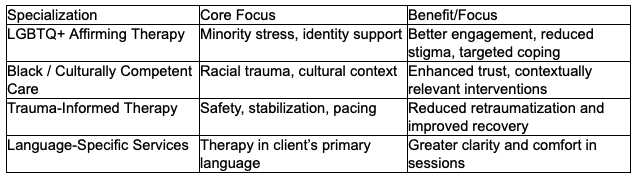
This comparison highlights how specialization aligns therapeutic focus with client identity and lived experience, increasing the effectiveness of care for diverse communities.
How Does LGBTQ+ Affirming Therapy Support Mental Health in NYC?
LGBTQ+ affirming therapy supports mental health by recognizing and addressing the effects of minority stress, internalized stigma, and identity-related trauma while validating identity and fostering resilience through targeted interventions. Clinicians trained in affirming practices use inclusive language, understand relevant legal and healthcare issues, and connect clients to community resources and supportive networks. Outcomes typically include improved self-acceptance, reduced anxiety and depression linked to stigma, and stronger social supports. Verifying a therapist’s LGBTQ+ competency through credentials, stated experience, or community referrals increases the chance of culturally responsive, effective care.
LGBTQ+ Affirming Therapy: Integrating Research and Clinical Application
Despite recent advancements in legal protections and increased social acceptance for LGBTQ+ individuals, they continue to face pervasive prejudice and discrimination, leading to higher rates of seeking therapeutic services compared to their heterosexual peers. As the demand for psychological services among LGBTQ+ individuals has grown, research in LGBTQ+ affirming therapy has emerged to address these needs. While the volume of scholarly articles and studies in this domain has expanded significantly since the early 21st century, a substantial disparity persists between research findings and their practical implementation. Research often offers generalized recommendations without detailing specific clinical strategies. Until the discourse prioritizes the practical application of LGBTQ+ affirming therapy, the mental health needs of this substantial and diverse population will remain inadequately addressed. Consequently, the primary objective of this endeavor is to examine the intersection of mental health and LGBTQ+ issues.
*Pride: A Review of LGBTQ+ Affirming Therapy Techniques and Recommendations for Clinical Practice, 2023
What Are the Benefits of Therapy with Black Therapists and Culturally Competent Care?
Therapy with Black clinicians or culturally competent care centers racial context in assessment and intervention, which can strengthen trust, reduce misdiagnosis, and surface culturally specific coping strategies that orthodox approaches may overlook. Culturally responsive therapists integrate understanding of systemic racism, intergenerational trauma, and community strengths into treatment planning and use interventions that resonate with clients’ identities. Practical steps to find such providers include searching specialty directories, asking about cultural competence during intake, and requesting referrals from community organizations. This culturally grounded approach often leads to higher engagement, more accurate formulations, and better long-term outcomes for clients from marginalized backgrounds.
Affirmative LGBTQ+ Therapy within a Dynamic Socio-Political Context
Delivering affirming and culturally competent care to LGBTQ+ clients necessitates that practitioners adeptly navigate the perpetually evolving socio-political environment. Macro-level legislation, policy directives, and even political discourse can exert immediate and profound influences on the health, well-being, and safety of LGBTQ+ individuals, both directly and indirectly. These indirect effects manifest through heightened societal polarization, strained interpersonal and familial connections, and elevated incidences of discrimination and victimization, all of which can precipitate or intensify adverse mental health outcomes. There are stressors that disproportionately impact LGBTQ+ populations, the distinctive strengths they embody, and their implications for case conceptualization and therapeutic intervention.*
*Setting the Stage for LGBTQ+ Affirmative Therapy, NA Livingston, 2025
How Do You Choose the Right Therapist in NYC?
Choosing the right therapist in NYC involves evaluating credentials, therapeutic specialization, approach compatibility, logistics (availability, location, telehealth), and financial fit to ensure both clinical effectiveness and practical sustainability. Core credentials to confirm include LCSW, LMHC, LMFT, psychologist, or psychiatrist, each indicating different training and scopes of practice; matching specialization (trauma, couples, LGBTQ+) to presenting needs increases the likelihood of a good fit. The intake or consultation is an opportunity to assess rapport, ask about evidence base for treatments, and clarify fees and insurance handling. The checklist below helps prioritize evaluation criteria when selecting a therapist.
Use this checklist to guide intake conversations and compare candidates methodically.
Verify credentials and licensure: Confirm the clinician’s state license and scope of practice.
Ask about specialization and experience: Request specifics on training for your concern.
Clarify approach and expected timeline: Ask how progress is measured and typical duration.
Confirm logistics and fees: Determine session frequency, cancellation policies, and payment options.
What Credentials and Specializations Should You Look for in NYC Therapists?
Look for credentials that match your needs: LCSW or LMHC for clinical counseling, LMFT for relationship work, psychologists for assessment and testing, and psychiatrists for medication management; each credential denotes different training and permissible services.
Specializations -- such as trauma, couples therapy, or LGBTQ+ affirming practice -- signal focused expertise and usually involve additional certifications or supervised experience. During intake, ask specific questions about training, case examples, and outcome expectations to assess fit and competence. Clear credential verification paired with specialty alignment increases the chance of effective, timely treatment.
How Can You Evaluate Therapy Approaches Like CBT, EFT, and Trauma Therapy?
Evaluating therapy approaches means understanding each method’s mechanism, target problems, and typical course: CBT restructures thoughts and behaviors for anxiety and depression; EFT targets attachment and emotional bonds for couples; trauma therapies like EMDR or trauma-focused CBT prioritize stabilization and processing of traumatic memories. Ask prospective therapists to describe how they apply these methods in sessions, what homework or between-session work they expect, and how progress is measured. Comparing approaches against your presenting problem and readiness for specific interventions helps determine the best fit. Once you select an approach, scheduling an initial consultation clarifies expectations and next steps for treatment planning.
Many providers maintain therapist profiles and online booking tools that streamline scheduling a consultation and viewing clinician specialties; consider using these resources to compare options and book an initial session. After selecting a candidate, prepare for the first meeting by collecting insurance information, identifying primary concerns, and noting questions about approach and logistics; this preparation improves the efficiency of intake. Scheduling a consultation allows you to evaluate rapport and practical fit before committing to ongoing sessions.
What Are Common Mental Health Issues Addressed by Counseling in NYC?
Counseling in NYC commonly treats anxiety, depression, trauma, stress, and relationship problems using evidence-based modalities matched to symptom profiles and client goals, with referrals to psychiatry for medication management when appropriate. Therapies such as CBT, DBT, EMDR, and interpersonal approaches offer specific mechanisms -- cognitive restructuring, emotion regulation, trauma processing, and communication training -- that translate to measurable symptom reduction and functional gains. Early identification of symptoms and prompt engagement with a therapist shortens the path to recovery and improves outcomes, and crisis resources are available for urgent needs. The next sections map therapies to anxiety/depression and to trauma/stress to help readers understand treatment pathways.
How Is Anxiety and Depression Treated Through Therapy in NYC?
Anxiety and depression are typically treated with evidence-based therapies -- CBT for distorted thoughts and avoidance, behavioral activation for depressed mood, and DBT for emotional dysregulation -- often combined with psychiatric evaluation for medication when indicated. The mechanism of CBT involves identifying and challenging unhelpful cognitions while building adaptive behaviors; behavioral activation increases engagement in rewarding activities to lift mood. Treatment timelines vary, with short-term CBT protocols often producing measurable change in 8–12 sessions for many clients, while more complex or comorbid cases may require longer-term work. Supplemental strategies such as mindfulness, exercise, and structured routines bolster therapy gains and support relapse prevention.
What Therapy Options Are Effective for Trauma and Stress in NYC?
Effective trauma and stress therapies include EMDR, trauma-focused CBT, somatic therapies, and stabilization-focused interventions that prioritize safety and pacing to prevent retraumatization. EMDR uses bilateral stimulation to process traumatic memories; trauma-focused CBT integrates exposure and cognitive processing with stabilization skills; somatic therapies address physiological patterns stored in the body. Trauma-informed care emphasizes consent, pacing, and co-regulation to ensure clients feel safe while processing difficult material. Finding trauma-informed providers who can offer phased treatment and coordinate with psychiatric or medical care when needed is crucial for safe and effective recovery.
Written by Aaron Skinner-Spain, LCSW-R
Executive Director, NYC Affirmative Psychotherapy
Pronouns: He/Him
Education: A.B., Cornell University; M.S.W., New York University
Training: Covenant House New York-Mother and Child Program; SCO Family of Services-GLBTQ Program; SCO Family of Services East New York-High School Suspension Program; New York University Counseling and Wellness Services; Training Institute for Mental Health; Trauma Research Foundation; Parnell Institute
License: New York State #080690
Post-Graduate Training and Certifications: Executive Healthcare Leadership, Cornell University; Supervisory Training Program, Training Institute for Mental Health; Four-Year Program, Psychoanalysis, Training Institute for Mental Health; Seminar in Field Instruction (SIFI), Fordham University; Undoing Racism Workshop; The People’s Institute for Survival and Beyond
Areas of Expertise: college mental health, depression, anxiety, panic attacks, LGBTQ affirmative therapy, childhood trauma, acute trauma, racial trauma and stress, coping skills, AF-EMDR, clinical supervision for therapists, entrepreneur, and executive stress