
Find Hope: Mental Health Support in the Community
Comprehensive Guide to Community Support:
Mental Health Services, Support Groups, and Benefits of Involvement
Community support encompasses services, groups, and relationships that help people meet emotional, informational, and practical needs. This guide explains what community support means, how mental health services and peer networks operate, and why involvement benefits individuals and society. Many face barriers when seeking help, so this article provides clear, actionable steps to find and access local resources. You will learn about social support types, mental health and crisis services, navigation strategies for directories, and how nonprofit programs serve vulnerable populations. The guide also covers contributing through volunteering and advocacy, with tables and checklists to simplify resource selection. This content uses current research and plain language to help you move from "I need help" to a concrete plan of action.
What Are the Types of Community Support and How Do They Help?
Community support includes four main types: emotional, informational, tangible, and esteem. Emotional support offers empathy and companionship, informational support provides guidance, tangible support delivers material aid, and esteem support reinforces self-worth. These mechanisms reduce stress, improve problem-solving, and stabilize daily life. Understanding these categories helps identify targeted programs like peer support for emotional needs or housing assistance for tangible needs.
Here are the four types with examples and benefits:
Emotional Support: Peer groups and listening services offer empathy and reduce isolation.
Informational Support: Online directories and case managers provide referrals and application guidance.
Tangible Support: Food banks, housing, and caregiver respite deliver direct material help.
Esteem Support: Mentoring and skill-building workshops restore confidence.
These categories produce outcomes like reduced loneliness and faster crisis stabilization. Recognizing your immediate need helps prioritize next steps.
How Do Different Community Support Services Address Diverse Needs?
Community services match offerings to populations based on eligibility, delivery models, and outreach strategies, fitting needs like age, language, mobility, or cultural background. Youth programs focus on emotional and informational support, while senior services prioritize tangible assistance and caregiver respite. Veteran services integrate employment and addiction recovery, and immigrant families benefit from multilingual informational support and legal referrals. Accessibility factors—transportation, hours, and documentation—are crucial. Addressing these barriers improves uptake and ensures the right support reaches the right people.
These strategies help readers identify tailored programs and move efficiently toward intake and enrollment.
How Do Community Mental Health Services Provide Support and Crisis Intervention?
Community mental health services offer layered care through outpatient therapy or counseling, peer support, crisis hotlines, mobile crisis teams, and walk-in centers. Outpatient therapy addresses ongoing conditions, peer support provides lived-experience guidance, and crisis services deliver rapid triage and safety planning. These services triage needs (assessment → stabilization → referral) and create warm handoffs to long-term care. Early intervention and coordinated crisis response reduce emergency department visits and promote faster recovery. Understanding each component helps individuals choose the most appropriate entry point during distress.
What Mental Health Support Groups and Peer Networks Are Available?
Support groups and peer networks include condition-specific, demographic-focused, clinician-led, and online forums. Peer-led groups build trust and coping strategies through lived experience, while clinician-led groups combine therapy techniques with group dynamics. Online groups expand access but require moderation guidance. To join, search community listings, ask a primary care provider for referrals, or contact local mental health organizations. First meetings typically involve introductions and confidentiality agreements.
How Do Crisis Intervention Programs Enhance Community Well-being?
Crisis intervention programs—hotlines, mobile crisis teams, and walk-in centers—offer immediate assessment, de-escalation, and linkage to further care via a call→triage→response workflow. Hotlines provide immediate support and can dispatch mobile teams; mobile teams coordinate with emergency services to reduce hospitalizations. These programs connect individuals to follow-up outpatient care, housing, or substance-use treatment, lowering repeat crisis episodes. Coordinated crisis response reduces emergency department utilization and improves linkage to long-term services. Knowing how to use crisis services builds community resilience.
What Are the Benefits of Community Involvement for Individuals and Society?
Community involvement improves mental health, reduces social isolation, strengthens civic cohesion, and creates resilient support networks. Individuals report improved mood, social connectedness, and purpose; society benefits from stronger safety nets that reduce reliance on costly emergency systems. These effects stem from increased social capital and shared resources, with programs connecting volunteers, service users, and professionals to improve service design. Studies link social integration to lower rates of depression and mortality, highlighting the public health returns of community support. Understanding these benefits motivates participation.
Reduced Isolation: Regular social contact lowers loneliness and improves mental health.
Improved Physical and Mental Health: Engagement correlates with reduced depression and better chronic disease management.
Civic Resilience: Active communities respond quickly to emergencies and sustain social services.
Economic Benefits: Volunteer-driven programs reduce public service costs.
How Does Community Support Reduce Isolation and Improve Mental Health?
Community support reduces isolation through repeated social contact, mutual aid, and meaningful roles, buffering stress and improving coping. Mechanisms include social integration, emotional regulation via shared experience, and increased access to informational resources. Evidence shows stronger social networks lead to lower depressive symptoms and better crisis recovery. Practical steps include joining peer groups, volunteering, and attending community classes. Simple actions like attending a group meeting or seeking warm referrals can improve mood and engagement, making community support an active tool for mental health maintenance.
What Role Does Volunteering Play in Strengthening Community Connections?
Volunteering offers reciprocal benefits: it expands community service capacity while improving volunteers’ social ties, skills, and sense of purpose. Roles range from mentoring to administrative assistance, often including training. Benefits for volunteers include improved well-being, reduced loneliness, and increased civic engagement, while communities gain sustained program delivery at lower cost. To find opportunities, seek organizations with clear onboarding, defined roles, and background checks. Starting with a short-term commitment helps assess fit. Volunteering strengthens networks that prevent and respond to community needs.
How Can Individuals Find and Access Local Community Support Resources?
Finding local community support involves defining your need, searching directories and government portals, verifying legitimacy, and initiating contact with required documentation. Online directories and government resources offer broad coverage, but combining sources improves accuracy. Case managers and community centers provide warm referrals, reducing wait times. Verification steps (calling to confirm services, eligibility, and checking for accreditation) protect safety and speed access. This triage flow leads to quicker service entry.
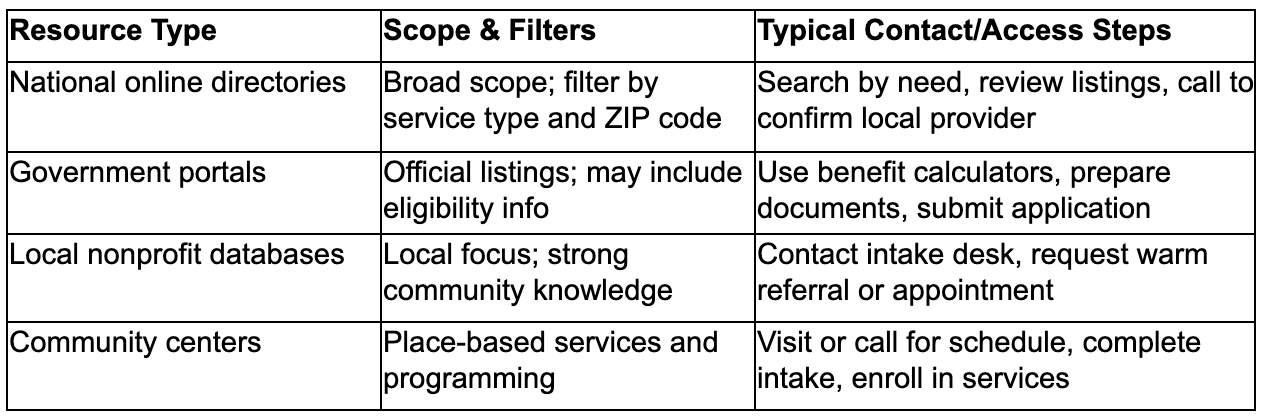
The table above compares common resource platforms to help you choose where to start your search.
What Are the Best Ways to Use Online Directories and Government Resources?
Efficient use of online directories requires targeted searches, careful filter use, and verification. Use specific terms like "housing assistance for veterans" with your city or ZIP code. Verify programs by calling to confirm hours, eligibility, and required documents; ask for a case manager if unsure. National portals offer scope, while local databases provide timely, community-specific listings; we recommend using both. These practices reduce dead ends and speed access.
Verify Service: Call to confirm availability and hours.
Ask Eligibility: Inquire about documentation and income requirements.
Confirm Safety: Ask about moderation, staff qualifications, and privacy policies.
Following these verification steps increases confidence and helps prioritize resources likely to accept you quickly.
How Do Nonprofit Community Programs and Support Groups Connect People?
Nonprofit programs connect people through referral networks, intake assessments, and partnerships. Pathways include self-referral, professional referrals, and outreach. Intake processes typically involve a needs assessment, documentation check, and scheduling. Partnerships with government agencies enable co-funded programs and streamlined eligibility. To speed access, bring identification, a summary of needs, and relevant medical/legal documentation to your first appointment. Asking for a caseworker ensures smoother transitions. These coordinated steps reduce duplication and improve continuity of care.
How Do Nonprofit Community Programs Support Vulnerable Populations?
Nonprofit community programs offer targeted housing, employment, addiction recovery, and caregiver supports through specialized services, case management, and public agency partnerships. Housing assistance includes emergency shelter, rental subsidies, and transitional housing; employment support features training, job placement, and subsidies. Addiction recovery services range from peer-led groups to medically assisted treatment linkages. Caregiver services include respite care, counseling, and skills training. Programs coordinate to address overlapping needs, using triage and cross-referral for integrated care.
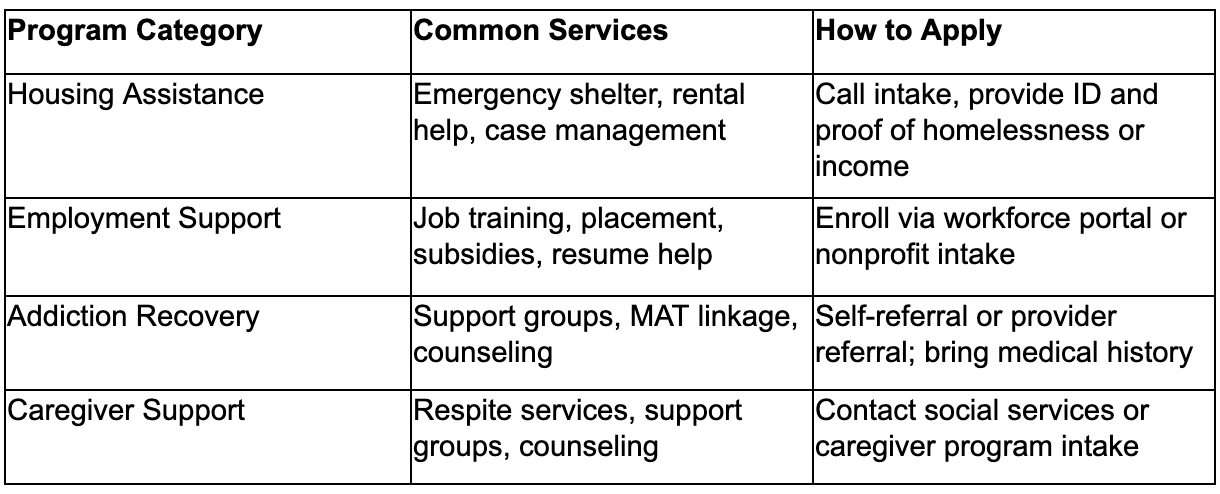
The table above compares typical program categories by services, eligibility, and application process.
What Services Do Housing Assistance and Employment Support Programs Offer?
Housing assistance programs provide emergency shelter, rental assistance, transitional housing, and case management for stability. Employment support emphasizes job readiness, vocational training, placement, and wage subsidies. Eligibility often depends on income, housing, or veteran status, requiring identification and income verification. Preparing documentation and requesting warm referrals speeds access. Coordinated housing-employment programs combining case management and job training yield better long-term outcomes.
How Are Addiction Recovery and Caregiver Support Groups Structured?
Addiction recovery options include peer-based 12-step groups, SMART Recovery, outpatient counseling, and linkages to medication-assisted treatment (MAT). Groups vary in facilitation (peer-led, clinician-led, hybrid) and frequency. Caregiver supports offer respite services, support groups, and counseling to reduce burnout. Respite can be in-home help or daycare. Integration with clinical services is common, with recovery groups referring to medical treatment and caregiver programs coordinating with social services. Understanding these formats helps choose programs matching availability and clinical needs.
How Can You Contribute to Community Support Through Volunteering and Advocacy?
Contributing to community support involves volunteering, advocacy, organizing donations, or mobilizing neighborhood networks to strengthen service capacity and influence systemic change. Effective volunteering requires assessing fit, understanding onboarding/background checks, and committing to roles with clear training. Advocacy includes contacting representatives, joining coalitions, and participating in public comment to secure funding or policy changes. Sustained engagement improves program quality and accessibility. This guidance helps you find suitable volunteer roles and launch advocacy efforts with local impact.
What Volunteer Opportunities Exist for Social Impact and Community Aid?
Volunteer roles include food distribution, youth mentoring, helpline staffing, administrative support, and event logistics, each with distinct time commitments and training. Organizations outline responsibilities, time expectations, and required background checks, often providing training. To evaluate opportunities, ask about supervision, measurable outcomes, and whether roles involve direct service or behind-the-scenes support. Short-term pilots allow testing fit. Matching skills and availability to organizational needs maximizes impact.
How Does Advocacy Help Improve Community Support Systems?
Advocacy influences funding, policy priorities, and program design by organizing community voices, engaging decision-makers, and presenting data-driven proposals. Mechanisms include coalition building, targeted campaigns for public funding, testimony at public hearings, and outreach to officials to change eligibility or strengthen service networks. Individuals can start by identifying a policy goal, joining a coalition, and using evidence or case examples. Measurable successes, like increased local funding or expanded clinic hours, result from sustained, organized advocacy backed by data and stories. Advocacy complements volunteer work by addressing upstream barriers to access and sustainability.