
Find an LGBTQ Therapist in NYC - Support You Deserve
How to Find and Benefit from an LGBTQ Therapist for Affirming Mental Health Support
Finding an LGBTQ therapist means locating a mental health provider who explicitly affirms queer and trans identities, reduces minority stress, and uses evidence-based approaches to improve wellbeing. This article explains what affirming therapy is, why it matters for sexual orientation and gender identity concerns, and how an affirming therapist uses specific modalities—such as CBT, trauma-informed care, and identity-affirming assessment—to produce measurable improvements in mood, functioning, and resilience. Many readers need practical steps for searching both locally and online, criteria for vetting clinicians, and concrete resources for youth, families, and allies; this guide provides clear checklists, clinician-selection comparisons, and actionable scripts to use during intake. You will also find concise mappings of common presenting issues (for example, minority stress, anxiety, depression, and trauma) to therapeutic responses, plus tables that compare benefits across populations and selection attributes for easy decision-making. Read on for structured guidance on finding an LGBTQ-friendly therapist, navigating intersectional needs, and accessing community and crisis supports that complement clinical care.
Why are an LGBTQ Therapist and Affirming Therapy Important?
An LGBTQ therapist is a mental health clinician who intentionally centers sexual orientation and gender identity in assessment and treatment, providing validation and clinical interventions that reduce stigma-related harm. This approach works by countering minority stress—external discrimination and internalized stigma—through validation, identity-affirming language, and targeted coping skills, which in turn improve mood, reduce anxiety, and increase social functioning. Recent research and clinical consensus emphasize that affirmation (not just neutrality) accelerates therapeutic alliance and reduces dropout among queer and trans clients. Understanding these mechanisms clarifies why seeking an affirming provider is a first step toward improving mental health outcomes for LGBTQ people. Below, two practical subsections describe what affirmation looks like in practice and how therapists support orientation and gender identity work.
What Does LGBTQ-Affirming Therapy Mean?
LGBTQ-affirming therapy means clinicians actively use chosen names and pronouns, maintain a non-pathologizing stance, and integrate knowledge of queer experiences into assessment and treatment plans. Affirming practice includes explicit intake language, intake forms that allow for diverse identity descriptions, and clinician willingness to correct mistakes and apologize without defensiveness. Clinicians also employ trauma-informed practices and culturally responsive interventions that recognize how family rejection, discrimination, and medical gatekeeping affect wellbeing. These behaviors contrast with superficial friendliness by demonstrating ongoing competency and accountability, and they form the foundation for effective identity-related work in therapy.
How Do LGBTQ Therapists Support Sexual Orientation and Gender Identity?
LGBTQ therapists support sexual orientation and gender identity through identity exploration, minority-stress coping skills, and coordination with community or medical resources when needed. Therapy goals commonly include reducing internalized stigma, improving assertive communication about identity, and increasing social support networks; modalities such as cognitive behavioral therapy (CBT), internal family systems (IFS), and trauma-focused approaches are frequently used. For clients pursuing medical transition, therapists may provide readiness assessments, referrals, and collaborative care planning with informed consent models that respect client autonomy. These clinical actions aim to increase gender euphoria, reduce dysphoria where present, and strengthen long-term resilience in social and occupational roles.
How Can You Find the Right LGBTQ Therapist for Your Needs?
Finding the right therapist combines targeted searching with careful vetting; begin by defining your priorities (e.g., trans-specific experience, youth expertise, telehealth access) and use directories, community centers, and telehealth platforms to compile options. The first step is a focused search using keywords like "lgbtq therapist," "gender identity exploration therapy," or "queer affirming counseling," then narrow candidates by checking clinician bios for explicit affirming statements, listed specialties, and training in trauma-informed or gender-affirming care. After this initial screening, prepare a short outreach script to ask about experience, modalities, insurance, sliding-scale availability, and telehealth options to confirm fit before scheduling an intake. The checklist below provides concrete vetting criteria and sample questions to use during a consultation.
Prioritize clinicians who explicitly state they provide affirming care and list relevant training or populations.
Ask whether the therapist has experience with your specific needs (transgender care, teen support, couples work) and which modalities they use.
Confirm logistics: insurance acceptance, sliding-scale fees, session length, telehealth availability, and confidentiality policies.
Use this checklist to reduce search time and increase the chance of a good therapeutic match. The next subsection provides a quick comparison table of selection attributes to help you weigh trade-offs between in-person and online options.
What Criteria Should You Use to Choose an LGBTQ Therapist?
When choosing a therapist, weigh identity concordance (if desired), explicit affirming language, relevant clinical experience, modalities offered, and practical logistics such as insurance and accessibility. Identity concordance (having a therapist who shares aspects of your identity) can be helpful but is not required when clinicians demonstrate high cultural competence; many clients prioritize therapist competence and trustworthiness over identity match. Ask specific questions during intake, such as "Do you have experience with gender-affirming care or with clients of my age/identity?" and "How do you handle name/pronoun changes in records and communications?" This focused vetting increases safety and accelerates progress in therapy, and the following subsection addresses how to access online affirming therapists while considering licensure and privacy.
Where Can You Access Online LGBTQ Therapy Services?
Online therapy expands access to LGBTQ-affirming clinicians, especially for those in rural areas or where local services are limited, but it requires attention to licensure, privacy, and platform vetting. Telehealth platforms and independent clinicians can offer secure video sessions; verify that the clinician is licensed to practice in your state or that the platform supports interstate care. Privacy considerations include where records are stored and whether session notes use chosen names or legal names; ask about secure messaging and safety planning for crises during remote sessions. For youth, confirm confidentiality boundaries and how guardians are involved; for adults, verify emergency procedures. These checks ensure that the convenience of online care does not compromise safety or affirmation.
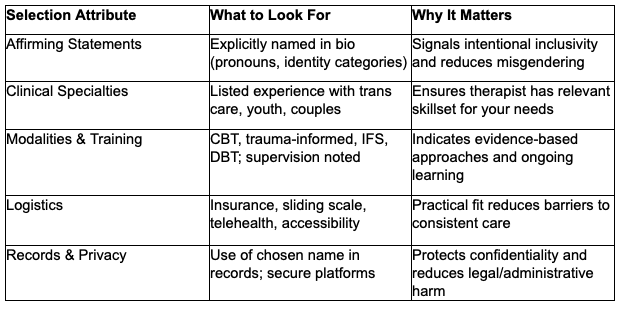
This table helps you weigh practical selection criteria that make therapy both effective and accessible.
The next H2 maps common mental health issues to therapeutic approaches so you can see typical treatment pathways.
What Mental Health Issues Do LGBTQ Therapists Commonly Address?
LGBTQ therapists commonly address a range of conditions tied to minority stress and identity-related experiences, including anxiety, depression, trauma, substance use, relationship challenges, and identity distress. Clinicians apply evidence-based interventions—CBT for mood and anxiety, trauma-focused therapies for PTSD symptoms, and family therapy for relational conflicts—while tailoring interventions to identity-specific stressors such as concealment, discrimination, and medical gatekeeping. Understanding which issues are most common and how they are treated helps clients set realistic goals and anticipate treatment phases. Below is an EAV-style table that maps conditions to typical presentations in LGBTQ clients and the therapeutic approaches most often recommended.
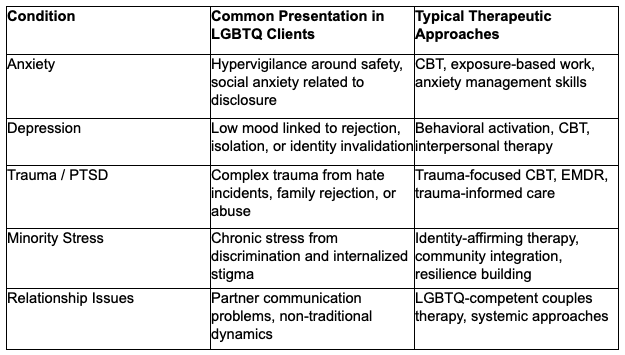
This table provides a quick-reference for how affirming therapists map problems to interventions.
The next subsection explains specific interventions for minority stress and mood symptoms and how short-term skills can complement longer-term identity work.
How Do LGBTQ Therapists Help with Minority Stress, Anxiety, and Depression?
Therapists address minority stress by combining validation with skill-building: normalizing reactions to discrimination, teaching cognitive reframing, and strengthening social supports to mitigate isolation. Interventions include CBT techniques to challenge internalized negative beliefs, behavioral activation for depressive symptoms, and targeted anxiety-management strategies such as grounding and exposure work. Therapists often integrate community resources and peer support to buffer stress effects and may use group therapy to increase connection and reduce shame. Recognizing signs of crisis and creating safety plans are essential parts of treatment; therapists help clients identify triggers, emergency contacts, and coping strategies while coordinating care when higher-level support is needed.
Research has demonstrated the effectiveness of LGB-affirmative cognitive-behavioral therapy in reducing minority stress among gay and bisexual men.
Source: LGB-Affirmative Cognitive Behavioral Therapy for Minority Stress in Gay and Bisexual Men
The intervention was designed to reduce cognitive, affective, and behavioral minority stress processes as experienced by gay and bisexual men, serving as mechanisms through which the adapted minority stress treatment could improve mental health. LGB-affirmative cognitive-behavioral therapy for young adult gay and bisexual men: A randomized controlled trial of a transdiagnostic minority stress approach., JE Pachankis, 2015
What Support Is Available for Coming Out, Relationships, and Family Dynamics?
Therapy for coming out, relationships, and family dynamics focuses on safety planning, communication skill-building, and psychoeducation for family members to reduce rejection and improve support. Coming-out work often includes stage-based planning (privacy and safety checks, timing, and scripting), while couples therapy addresses queer-specific dynamics such as negotiated non-monogamy or blended family issues with culturally competent frameworks. Family therapy emphasizes education about gender and sexual diversity, strategies for repairing relationships, and referrals to supportive community resources. These approaches aim to increase relational stability and reduce the long-term mental health impact of family conflict or rejection.
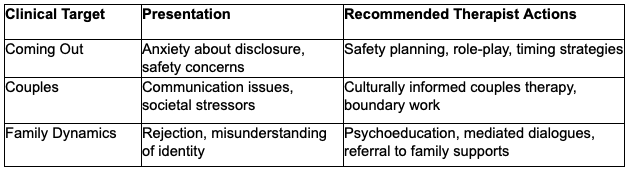
This concise mapping clarifies typical therapeutic actions used in relational and coming-out contexts.
The following H2 explores specific benefits of gender-affirming therapy and queer counseling with comparative detail.
What Are the Benefits of Gender Affirming Therapy and Queer Counseling?
Gender-affirming therapy and queer-specific counseling produce psychological, social, and functional benefits by affirming identity, reducing dysphoria, and connecting individuals to community and medical resources when needed. Mechanistically, affirmation reduces minority stress and internalized stigma, which lowers rates of depression and suicidal ideation and increases quality of life and social functioning. Evidence from recent clinical literature indicates that access to affirming clinicians correlates with improved mental health outcomes, higher treatment retention, and greater readiness for medical decision-making where appropriate. The table below compares primary benefits across transgender, nonbinary, and gender-questioning populations to illustrate differential impacts and expected outcomes.
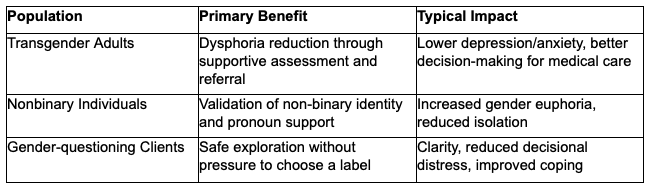
The comparative table shows that while all groups gain from affirmation, outcomes vary by goals and context.
The subsections below detail therapeutic roles in supporting trans and nonbinary clients and the preventive role of queer therapy in long-term wellness.
How Does Gender Affirming Therapy Support Transgender and Nonbinary Individuals?
Gender-affirming therapy supports transgender and nonbinary clients through exploration, readiness assessments, referral coordination, and ongoing psychosocial support before, during, and after medical steps if pursued. Clinicians perform nuanced assessments to help clients articulate goals, manage expectations, and connect with knowledgeable medical providers when desired, while also treating co-occurring mood or trauma symptoms that can complicate care. Therapeutic collaboration with surgeons or endocrine teams often uses informed-consent frameworks that respect client autonomy and reduce unnecessary gatekeeping. These clinical practices lead to measurable improvements in mental health metrics, higher satisfaction with care pathways, and stronger social integration for many clients.
What Role Does Queer Therapy Play in Building Mental Wellness?
Queer therapy contributes to long-term mental wellness by offering preventive care, resilience-building strategies, and community linkage to peer supports and resources that sustain recovery and growth. Beyond treating acute symptoms, therapists help clients develop ongoing coping strategies, pursue affirming social networks, and plan for life transitions that support sustained wellbeing. Preventive approaches include psychoeducation, skill-based groups, and relapse-prevention planning tailored to the realities of stigma and discrimination. By integrating community referral pathways and peer-support networks, queer therapy reduces isolation and promotes durable improvements in quality of life.
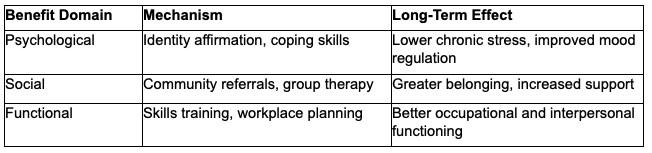
These domain-level linkages show how queer therapy moves beyond symptom reduction to produce sustained wellness.
Next we address the important role of intersectionality in shaping therapy needs and outcomes.
How Does Intersectionality Influence LGBTQ Therapy and Mental Health Care?
Intersectionality—how sexual orientation or gender identity intersects with race, religion, disability, and other identities—shapes access, trust, and clinical strategies in LGBTQ therapy by adding layers of discrimination and resilience. Therapists who adopt intersectional assessment gather layered identity information to identify compounded stressors and protective factors, which then inform culturally adapted interventions that respect faith, cultural norms, or disability accommodations. Failure to account for intersectionality can lead to misdiagnosis, disengagement, or ineffective interventions, making cultural competence central to safe and effective care. The subsections that follow explain markers of competence and concrete strategies for clinicians addressing multiple marginalized identities.
Why Is Cultural Competence Critical in LGBTQ Therapy?
Cultural competence in LGBTQ therapy entails clinician knowledge of cultural contexts (racial and ethnic identity, religion, age), humility about differences, and specific practices such as asking open questions about faith and chosen family. Markers of competence include training in culturally adapted interventions, supervision or consultation on intersectional cases, and demonstrable use of inclusive intake processes. Clients can assess competence by asking about experience with similar identity intersections and requesting examples of culturally adapted strategies. These practices strengthen therapeutic alliance and improve retention, so cultural competence is both an ethical necessity and a clinical asset.
Trauma-informed and affirmative mental healthcare practices are essential for creating a safe and effective therapeutic environment for LGBTQ+ individuals.
Source: Trauma-Informed and Affirmative Mental Healthcare for LGBTQ+ Individuals
Trauma-informed and affirmative mental healthcare practices are crucial for serving LGBTQ+ clients. Mental health services should function as a sanctuary, ensuring clients feel secure, respected, and understood. Trauma-informed approaches can foster resilience and equip clients with effective coping strategies for navigating life's adversities. Trauma-informed and affirmative mental health practices with LGBTQ+ clients., JS Levenson, 2023
How Do Therapists Address the Intersection of LGBTQ Identity with Race, Religion, and Disability?
Therapists address intersections by conducting multi-layered assessments that identify unique risk and resilience profiles, tailoring interventions to respect cultural or religious contexts, and coordinating with community-specific resources. Strategies may include faith-aware counseling that honors religious identity while supporting sexual or gender identity, disability accommodations for sensory or mobility needs, and referrals to culturally specific peer supports. Case examples often show therapists combining psychoeducation for family members with community liaison work to reduce barriers and cultivate ally networks. This integrated approach increases relevance and effectiveness of therapy for clients with intersecting identities.
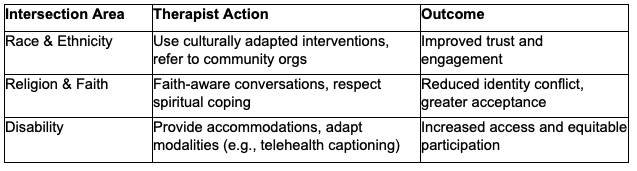
This table demonstrates practical strategies for intersectional care and how tailored actions produce better engagement.
The final H2 lists resources beyond therapy for individuals, families, and youth.
What Resources and Support Are Available Beyond Therapy for LGBTQ Individuals and Allies?
Outside of individual therapy, a network of crisis lines, peer-support groups, educational resources for allies, and youth-focused services complement clinical care and build protective community structures. These resources include anonymous crisis supports for urgent safety needs, peer-run groups for connection and skill practice, educational toolkits for families to reduce rejection, and school-based or clinic-based youth services that offer confidential guidance. Learning how to access these resources enhances resilience and provides practical supports during therapy gaps or transitions. The subsections below provide actionable tools for families and pathways youth can use to find safe, affirming care.
Below is a short list of non-clinical supports commonly used to supplement therapy and improve outcomes.
Peer support groups that provide shared experience, coping strategies, and social connection.
Educational resources for families and allies that include scripts for supportive conversations and advocacy tips.
Crisis and helpline resources for urgent safety planning and immediate emotional support.
These supports work alongside therapy to create a safety net; the following subsection gives specific guidance families and allies can use to support loved ones.
Interventions aimed at reducing sexual minority stress can be enhanced by prejudice reduction strategies and the implementation of gay-affirmative policies, alongside increased affirmation from support systems.
Source: Reducing Sexual Minority Stress: A Review of Intervention Toolkits
This review examines interventions designed to mitigate sexual minority stressors, such as prejudice reduction and the implementation of gay-affirmative policies. Furthermore, to decrease the probability of future stressors, the therapeutic approach facilitates increased affirmation from family members and other support systems. What reduces sexual minority stress? A review of the intervention “toolkit”, SR Chaudoir, 2017
What Mental Health Resources Can Families and Allies Use to Support LGBTQ Loved Ones?
Families and allies can use psychoeducational materials, structured communication scripts, and local support groups to provide consistent, evidence-informed support to LGBTQ loved ones. Practical actions include using chosen names and pronouns consistently, engaging in active listening without pressuring identity outcomes, and seeking family therapy or parent support groups to address conflicts. Allies can also learn to advocate for services at schools and medical settings, and to create safety plans when youth face rejection; a brief sample conversation script can reduce harm and open pathways to support. These actions both increase relational repair and reduce mental health risk factors associated with rejection and isolation.
How Can LGBTQ Youth Access Safe and Affirming Mental Health Spaces?
LGBTQ youth can access safe care through school counselors with affirming training, youth clinics that offer confidential services, telehealth options with youth-experienced clinicians, and peer-led support groups designed for minors. Confidentiality and consent vary by jurisdiction, so youth should ask clinicians about privacy, mandatory reporting rules, and how guardians are involved; clinicians often provide harm-minimizing plans when parental support is limited. Schools and community centers can connect youth to supportive peers and resources, while telehealth expands access to specialists otherwise unavailable locally. These pathways help youth obtain timely, affirming support that complements in-person services.
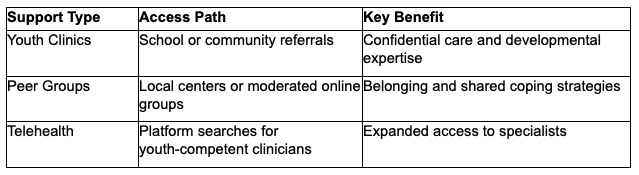
This table summarizes ways youth can find affirming care and the unique benefits of each path. Use these resources alongside therapy to build robust support systems that protect wellbeing and foster resilience.
Written by Aaron Skinner-Spain, LCSW-R
Executive Director, NYC Affirmative Psychotherapy
Pronouns: He/Him
Education: A.B., Cornell University; M.S.W., New York University
Training: Covenant House New York-Mother and Child Program; SCO Family of Services-GLBTQ Program; SCO Family of Services East New York-High School Suspension Program; New York University Counseling and Wellness Services; Training Institute for Mental Health; Trauma Research Foundation; Parnell Institute
License: New York State #080690
Post-Graduate Training and Certifications: Executive Healthcare Leadership, Cornell University; Supervisory Training Program, Training Institute for Mental Health; Four-Year Program, Psychoanalysis, Training Institute for Mental Health; Seminar in Field Instruction (SIFI), Fordham University; Undoing Racism Workshop; The People’s Institute for Survival and Beyond
Area(s) of Expertise: college mental health, depression, anxiety, panic attacks, LGBTQ affirmative therapy, childhood trauma, acute trauma, racial trauma and stress, coping skills, AF-EMDR, clinical supervision for therapists, entrepreneur, and executive stress