
Navigate Love: Expert Marriage Counseling NYC Solutions
Comprehensive Guide to Marriage Counseling NYC:
Find the Best Couples Therapy and Relationship Support
Marriage counseling in NYC helps couples improve communication, resolve conflict, and rebuild intimacy by using evidence-based therapeutic methods tailored to diverse urban needs.
This article explains what marriage counseling is, how it works, and why the range of specialties—from culturally competent care to teletherapy—matters for couples seeking sustainable relationship change. Readers will learn the main modalities used in couples work, how therapy addresses common issues like infidelity or parenting stress, practical cost and insurance guidance, and step-by-step criteria for choosing the right therapist in Manhattan, Brooklyn, Queens, and online. The guide emphasizes actionable advice: how to evaluate therapists’ credentials, when to prefer EFT versus the Gottman Method, and where sliding-scale or community resources can make treatment affordable. Throughout, the piece integrates lexical signals such as LMFT, LCSW, teletherapy, and billing code references so you can match clinical needs to practical options in NYC’s therapy landscape.
What Is Marriage Counseling and How Can It Help Couples in NYC?
Marriage counseling, also called couples therapy or relationship counseling, is a structured clinical process where two partners work with a licensed clinician to change unhelpful interaction patterns and build emotional connection. The mechanism involves assessment, identifying negative cycles, teaching communication skills, and assigning targeted exercises that rewire responses; this process improves conflict management and emotional safety over time. In New York City, clinicians often adapt these methods to urban stressors—long commutes, high-pressure careers, and cultural diversity—so outcomes reflect both individual and contextual factors. Current research and practice emphasize outcomes like improved communication, reduced relationship distress, and prevention of escalation; these results are more likely when couples engage with a modality matched to their presenting issues. The next sections break down the concrete benefits and the ways therapy tackles common relationship problems so you can decide if marriage counseling fits your goals.
What Are the Benefits of Couples Counseling in New York City?
Couples counseling delivers measurable improvements in communication, conflict resolution, and emotional intimacy by teaching partners specific interaction skills and emotional regulation techniques. The therapeutic process reduces destructive patterns—criticism, stonewalling, and avoidance—and replaces them with structured rituals, repair strategies, and homework that strengthen daily connection. For NYC couples, additional benefits include access to specialists for culturally specific needs and flexible scheduling with teletherapy options that suit busy urban lives. Research-backed benefits also include improved co-parenting coordination, decreased depression and anxiety symptoms tied to relationship stress, and an increased capacity for proactive relationship maintenance. Understanding these advantages leads naturally to how marriage therapy addresses specific issues like infidelity, trust, and parenting stress in practical clinical terms.
Couples counseling offers improved communication skills that reduce repeated arguments.
Therapy supports rebuilding trust after betrayals through structured repair and transparency.
Sessions teach shared problem-solving strategies, improving decisions about finances, parenting, and life transitions.
These benefits show why early or preventive couples work can be more effective than waiting for crisis-level problems; the next subsection explains typical therapeutic techniques used to address common issues.
How Does Marriage Therapy Address Common Relationship Issues?
Marriage therapy begins with an intake assessment that clarifies goals, identifies interactional patterns, and establishes measurable outcomes, which guides a customized treatment plan. Therapists use methods like role-plays, structured dialogues, and assignments to practice new skills between sessions, which accelerates learning and embeds changes in daily life. For infidelity, therapists typically combine processing of emotions, accountability planning, and rebuilding transparency; for communication breakdowns, they teach turn-taking, reflective listening, and de-escalation techniques tied to the couple’s specific triggers. Therapy also links to individual mental health needs—anxiety, depression, or trauma—so clinicians coordinate care or refer when necessary, strengthening overall outcomes. These intervention mechanics lead naturally to a comparison of the main therapeutic modalities available in NYC and how to choose among them.
Which Types of Marriage Counseling Are Available in NYC?
NYC couples can access a range of therapeutic modalities—each with distinct theory, session structure, and outcomes—so understanding core differences helps match treatment to presenting problems.
Major approaches include Emotionally Focused Therapy (EFT), the Gottman Method, Cognitive Behavioral Couples Therapy (CBCT), psychodynamic couples work, and integrative models that blend techniques based on assessment.
Clinicians choose modalities according to goals: attachment repair often calls for EFT, communication skill-building aligns with the Gottman Method, and behavior-change or thought-pattern work uses CBCT.
The table below compares the most used approaches to help you decide which aligns with your priorities and timeline.
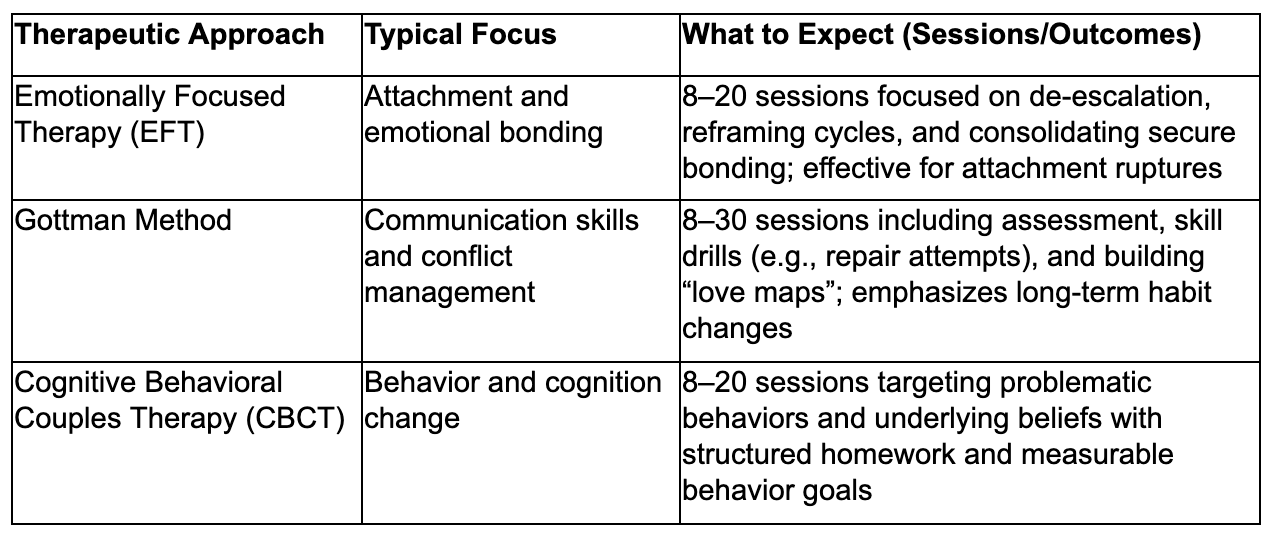
This table clarifies modality differences so couples can prioritize attachment work, skill-building, or cognitive/behavioral change
The next paragraphs describe EFT and other methods in more detail.
What Is Emotionally Focused Therapy and How Does It Work?
Emotionally Focused Therapy (EFT) is a short-to-medium-term modality that focuses on adult attachment needs and patterns of emotional engagement to create secure bonding between partners. Clinicians map negative interaction cycles, help partners access and express vulnerable emotions, and guide corrective experiences that reshape relational expectations; the phases progress from de-escalation to restructuring and consolidation.
EFT sessions often include experiments where partners practice new responses to attachment triggers while the therapist coaches repair and validation, which accelerates trust rebuilding.
Empirical evidence shows EFT produces durable gains in relationship satisfaction and reduction in distress for many couples, particularly where attachment injury or emotional withdrawal is central.
Understanding EFT’s attachment lens provides a contrast to skills-based approaches like the Gottman Method, which you can read more about in this post.
How Do Specialized Couples Therapy Services Support Diverse NYC Communities?
Specialized couples therapy adapts standard interventions to the cultural, social, and identity contexts of couples so treatment resonates with lived experience and community-specific stressors.
In NYC, clinicians may integrate cultural values, faith considerations, immigration-related stress, or minority stress frameworks into couples work, which improves engagement and outcomes.
Culturally competent practice includes clinician training, awareness of systemic factors, and use of inclusive language and interventions that honor each partner’s identity and community ties.
Evaluating cultural competence in a therapist involves asking about experience, training, and therapeutic approaches relevant to your background; the following subsections dive into LGBTQ+-affirming and Black couples–focused care and what to look for in a therapist.
What Is Gay Couples Therapy in NYC and Why Is It Important?
Gay couples therapy or LGBTQ-affirming couples therapy explicitly addresses identity-linked stressors—minority stress, coming-out dynamics, and stigma-related trauma—while also applying standard couples interventions to relationships.
An affirming clinician recognizes the impact of external stressors on intimacy, validates identity experiences, and adapts communication and repair exercises to same-sex and gender-diverse relationships. At NYC Affirmative Psychotherapy, we practice affirming therapy styles.
Practical therapist attributes include familiarity with LGBTQ community resources, use of inclusive language, and specific strategies for identity-related family dynamics or legal/healthcare stress.
Affirming care improves outcomes by reducing shame, increasing emotional safety, and providing targeted coping strategies for discrimination-related strain.
How Does Black Couples Therapy Provide Culturally Competent Support?
Black couples therapy centers cultural strengths, systemic stressors, and community values—such as extended family roles and faith influences—while addressing relationship dynamics using evidence-based techniques.
Clinicians who work effectively with Black couples integrate awareness of racism, historical trauma, and socioeconomic pressures into case conceptualization and therapeutic goals, tailoring interventions to respect cultural norms and resiliency factors.
Practical examples include reframing conflict within systemic contexts, leveraging culturally meaningful rituals to rebuild connection, and incorporating community resources when appropriate.
When interviewing a therapist, ask about experience with Black couples, examples of culturally adapted interventions, and openness to integrating clients’ spiritual or family systems; this verification step leads naturally to deciding between online and in-person therapy formats.
What Are the Differences Between Online and In-Person Marriage Counseling in NYC?
Online and in-person couples therapy share core clinical methods, but format differences affect accessibility, convenience, and certain clinical tasks, making format choice dependent on goals, logistics, and severity of issues.
Teletherapy increases access to niche specialists across boroughs and supports scheduling flexibility for busy NYC lives, while in-person sessions may be preferable for high-intensity work, assessments, or when privacy and nonverbal cues are essential.
Licensing and legal considerations matter: clinicians must be licensed in the state where the client is located, so confirm licensure for interstate or cross-state sessions.
Practical guidance on format choice considers safety, technological readiness, and the nature of presenting problems; the next subsections outline teletherapy benefits and tips, then how to find qualified in-person therapists in Manhattan and beyond.
What Are the Benefits of Virtual Couples Therapy for NYC Residents?
Virtual couples therapy provides convenience, wider therapist choice, and the ability to include partners in different locations while preserving continuity of care despite busy work schedules or childcare constraints.
Research shows teletherapy can be as effective as in-person therapy for many relationship issues when clinicians adapt interventions to the video format and ensure privacy and technological stability.
Practical tips for successful teletherapy include securing a private space, testing audio/video beforehand, and agreeing on contingency plans in case of crisis; clinicians also set clear boundaries about emergency protocols and session etiquette.
For couples balancing demanding NYC schedules or seeking niche specializations that aren’t locally available, teletherapy expands access without sacrificing many core treatment elements.
How to Find Qualified In-Person Marriage Therapists in Manhattan and Beyond?
Finding a qualified in-person therapist involves verifying licensure (LMFT, LCSW, or similar), checking specialized training (EFT certification, Gottman training), and reviewing experience with your presenting issues or community background.
Use trusted directories and professional associations to compile candidates, then ask targeted intake questions about modality, session length, and experience with culturally specific populations; an initial consult helps assess fit and logistics.
Office visits give practical information about accessibility, safety, and whether the clinic environment supports focused work; consider commute time and scheduling flexibility as they influence consistency.
Confirming credentials and fit sets the stage for understanding cost and insurance coverage, which is the next major consideration for NYC couples seeking sustainable care.
How Much Does Marriage Counseling Cost in NYC and Is It Covered by Insurance?
Marriage counseling costs in NYC vary widely and depend on therapist credentials, neighborhood, and in-person versus teletherapy format; typical per-session rates often range across a broad spectrum reflective of urban markets.
Insurance coverage for couples therapy is complicated: many insurers cover family therapy or marriage counseling only when billed as family therapy with a psychiatric diagnosis, and billing codes such as (family therapy with patient present) are commonly referenced in clinical billing discussions.
Affordability strategies include sliding-scale fees, community mental health clinics, training clinics at universities, and carefully negotiated packages or reduced-rate blocks; transparency about fees and billing practices is essential during intake.
The following subsections present realistic price ranges and actionable steps for using insurance and sliding-scale options to make therapy accessible.
What Is the Typical Price Range for Couples Therapy Sessions in NYC?
Session fees in New York City reflect clinician credentials, office location, and demand; while exact figures vary, many couples can expect a broad range where experienced specialists charge higher hourly rates and trainees or community clinics offer lower-cost options.
Factors that increase fees include specialist training (EFT certification, advanced trauma work), private practice in Manhattan, and in-person sessions with high overhead; teletherapy and trainee clinics often provide more affordable alternatives.
At NYC Affirmative Psychotherapy, sessions are covered by many insurance plans, and the out of pocket fee is $175 per session. For those who need a lower fee, we offer a no questions asked sliding scale fee structure. At this time our $90 and $125 rates are available, and $70 sessions are available with our Advanced Clinical Interns.
When comparing providers, ask about session length, cancellation policies, package discounts, and whether the clinician offers sliding scale or pro bono options; these questions clarify total cost and financial commitment.
Clear fee inquiries during initial contact reduce surprises and help couples select sustainable care; the next subsection explains how to use insurance and find sliding-scale services practically.
This table provides a transparent snapshot of cost drivers and insurance notes for NYC couples.
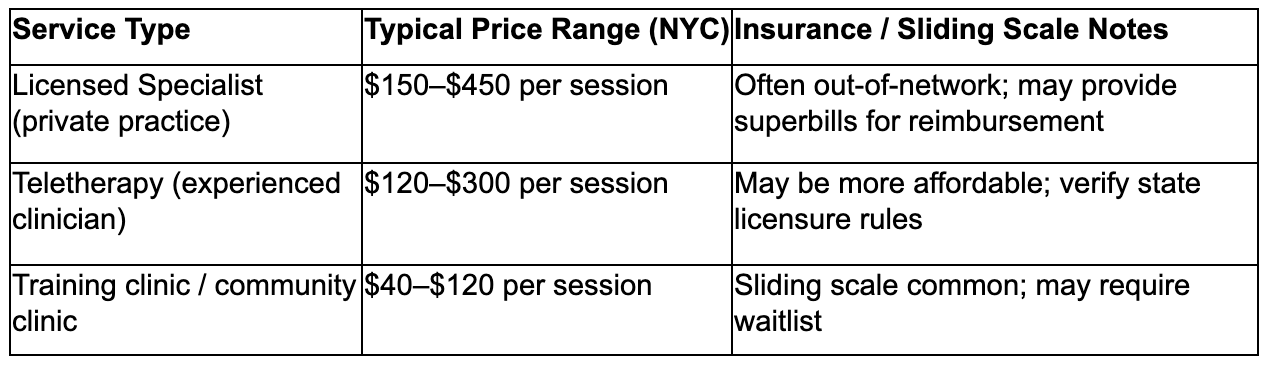
This therapy cost overview highlights options across price points so couples can plan financially and pursue sliding-scale or community resources as needed.
How Can Couples Use Insurance and Sliding Scale Fees for Affordable Therapy?
To use insurance, ask prospective clinicians whether they accept your plan, whether couples work will be billed under a family therapy code like , and what diagnoses might be required for coverage; obtain a preauthorization or benefits verification when possible.
If out-of-network, request a superbill (itemized receipt) from the clinician to submit for partial reimbursement, and compare expected out-of-pocket costs with sliding-scale or package options offered by the clinician.
For sliding scale, ask about eligibility criteria and whether reduced fees are time-limited or ongoing; university training clinics and nonprofit organizations often provide long-term, lower-cost care.
These affordability strategies help couples maintain continuity of care while managing finances and lead naturally into guidance on selecting the right therapist for your relationship needs.
How to Choose the Best Marriage Therapist in NYC for Your Relationship Needs?
Choosing the right marriage therapist combines verification of credentials with evaluation of therapeutic fit, modality alignment, logistics, and cultural competence to ensure effective work and sustained engagement.
Essential steps include confirming licensure (LMFT, LCSW, or equivalent), checking modality training (EFT certification, Gottman training), and assessing experience with specific issues such as infidelity, blended families, or LGBTQ+ concerns.
Use initial consultations to evaluate rapport, clarity about goals, and the therapist’s plan for measurement and progress review; a good initial consult also clarifies session structure and homework expectations.
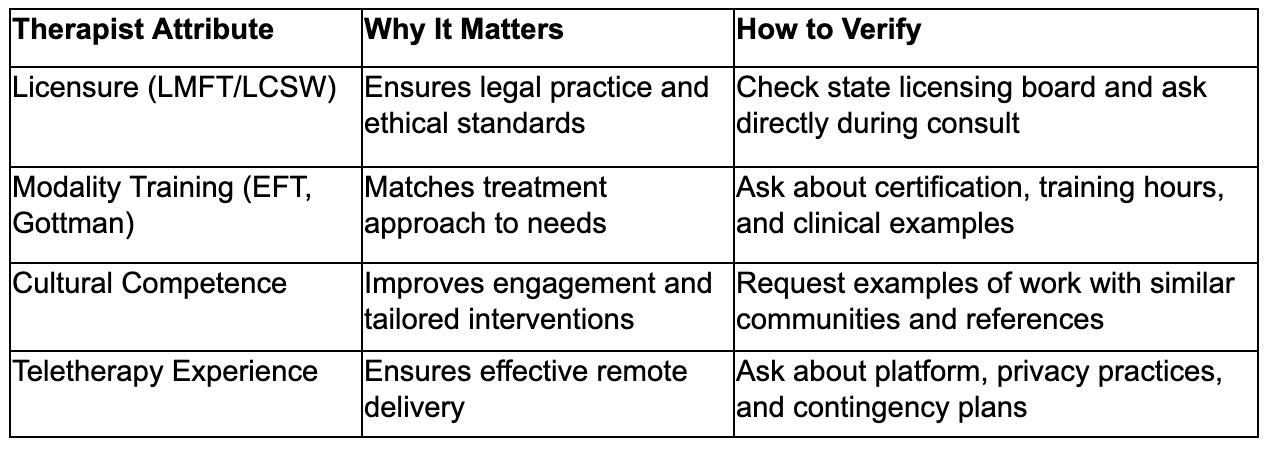
This table offers a practical checklist—Therapist Attribute, Why It Matters, and How to Verify—to guide interviews and decisions.
This checklist helps couples create a shortlist of therapists who meet both technical and relational criteria; the following subsections offer concrete qualifications to seek and how to use initial consultations effectively.
What Qualifications and Specializations Should You Look for in a NYC Therapist?
Look for valid licensure (LMFT, LCSW, or equivalent), formal training in relevant modalities (EFT certification, Gottman training, CBCT courses), and documented experience with your presenting issues or communities, which signals competence and ethical practice.
Red flags include vague answers about training, reluctance to share supervision history if early-career, or absence of clear treatment plans and measurable outcomes; ask about these directly during intake.
Also inquire about their approach to co-occurring individual mental health issues and whether they coordinate care with psychiatrists or medical providers when necessary.
Confirming these qualifications gives you a practical baseline for expecting responsible, evidence-informed couples work.
How Can Initial Consultations Help You Find the Right Couples Counselor?
Initial consultations are diagnostic conversations where you assess rapport, the therapist’s listening style, and whether their proposed plan aligns with your goals; use this time to ask about modality, expected session cadence, measurable outcomes, and homework policies.
Sample questions include: “What is your experience with couples like us?”, “Which modality would you recommend and why?”, and “How will we track progress and decide when to taper sessions?”; the therapist’s responses reveal clarity, transparency, and a collaborative stance.
Evaluate emotional safety during the consult—do you feel heard, respected, and understood—and compare impressions across candidates if needed.
Ask about licensure, modality training, and sliding-scale availability during the first contact.
Use consistent questions across therapists to compare fit and treatment plans objectively.
Trust both objective criteria and your subjective sense of rapport when deciding.
These action steps complete the decision framework for finding high-quality couples counseling in NYC and prepare you to begin focused, effective work on your relationship.
Written by Aaron Skinner-Spain, LCSW-R
Executive Director, NYC Affirmative Psychotherapy
Pronouns: He/Him
Education: A.B., Cornell University; M.S.W., New York University
Training: Covenant House New York-Mother and Child Program; SCO Family of Services-GLBTQ Program; SCO Family of Services East New York-High School Suspension Program; New York University Counseling and Wellness Services; Training Institute for Mental Health; Trauma Research Foundation; Parnell Institute
License: New York State #080690
Post-Graduate Training and Certifications: Executive Healthcare Leadership, Cornell University; Supervisory Training Program, Training Institute for Mental Health; Four-Year Program, Psychoanalysis, Training Institute for Mental Health; Seminar in Field Instruction (SIFI), Fordham University; Undoing Racism Workshop; The People’s Institute for Survival and Beyond
Area(s) of Expertise: college mental health, depression, anxiety, panic attacks, LGBTQ affirmative therapy, childhood trauma, acute trauma, racial trauma and stress, coping skills, AF-EMDR, clinical supervision for therapists, entrepreneur, and executive stress