
Counseling New York: Your Complete Guide to Individual, Family, and Online Therapy Services
Counseling New York describes the range of mental health services available across New York state and New York City, including individual therapy, couples and marriage counseling, family work, group formats, and teletherapy options. This guide explains what each type of counseling does, why specific approaches work for anxiety, trauma, or relationship challenges, and how to evaluate and contact licensed therapists in New York.
Many New Yorkers face barriers like cost, language, and insurance complexity; this guide offers clear steps to navigate these obstacles and find culturally responsive care. Read on for service types, modality guides (CBT, EMDR, DBT, EFT), teletherapy notes, a therapist-search checklist, and answers to common questions about cost and the difference between counseling and therapy. Local considerations like bilingual providers and LGBTQ+ affirming care are integrated to help your search.
What Types of Counseling Services Are Available in New York?
Counseling services in New York span core formats—individual, couples, family, group, and teletherapy—addressing distinct goals with specific methods. Each type is chosen based on presenting problems, relationship dynamics, and logistical needs. Knowing when to choose each option helps match needs to evidence-based interventions.
Common service types available across New York include:
Individual therapy: Focuses on symptom relief, coping skills, and insight for anxiety, depression, and stress.
Couples & marriage counseling: Targets communication patterns, conflict resolution, and relationship repair.
Family counseling: Works with family systems to address transitions, adolescent issues, and caregiving challenges.
Group therapy: Provides peer-supported skill-building for conditions like social anxiety, grief, or addiction.
Online/teletherapy: Offers remote access to licensed clinicians when in-person care is not feasible.
These formats inform next steps in modality selection and what to expect in initial sessions, explored in individual and family subsections below.
Service Type: Typical Uses & Conditions Treated / Typical Session Format / Who it's best for
Individual therapy: Anxiety, depression, stress, life transitions / In-person or teletherapy; weekly 45–60 min / Individuals seeking symptom relief or personal growth;
Couples & marriage counseling: Relationship conflict, communication, infidelity / In-person or teletherapy; joint sessions / Couples aiming to repair or strengthen relationship;
Family counseling: Parent-teen conflict, medical caregiving, divorce transitions / In-person or hybrid; multi-member sessions / Families needing system-level change;
Group therapy: Social anxiety, grief, substance use recovery / Group sessions in-person or online / People benefiting from peer support and skills practice;
Teletherapy: Accessibility, convenience, continuity / Video or phone sessions / Those with mobility, scheduling, or geographic constraints.
How Does Individual Therapy in New York Support Mental Well-being?
Individual therapy at NYC Affirmative Psychotherapy supports mental well-being by combining a licensed clinician’s assessment with evidence-based interventions tailored to personal goals, such as symptom reduction, coping skill development, and insight. Therapists commonly use modalities like cognitive behavioral therapy (CBT), psychodynamic work, and mindfulness-based approaches. A typical session includes a check-in, focused intervention, and a collaborative plan for between-session work. Understanding common modalities helps you ask the right questions during intake.
Choosing a modality is often guided by symptom profile and preference; CBT suits measurable symptom reduction, while psychodynamic work suits long-term relational insight. This leads naturally into family counseling, which applies systemic principles to relational difficulties.
What Are the Benefits of Family Counseling in New York?
Family counseling applies systemic therapy principles to improve communication, reduce conflict, and strengthen functioning across household roles, often focusing on transitions like adolescence, caregiving, or divorce. Sessions typically include multiple family members and use approaches such as structural family therapy or attachment-focused work to reframe patterns. Family counseling often involves fewer total sessions than prolonged individual work when the core problem is relational. Knowing how family sessions are structured makes it easier to schedule and set realistic goals.
Recognizing when family counseling is the right step—such as during transitions or caregiving strain—prepares families to commit to systemic change, which we next relate to specialized therapies for anxiety and trauma.

Family counseling sessions typically include multiple family members.
How Can Specialized Therapies Address Anxiety and Trauma?
Specialized therapies for anxiety and trauma at NYC Affirmative Psychotherapy deploy targeted interventions—like CBT for anxiety and EMDR or trauma-informed sensorimotor approaches for trauma—that address underlying mechanisms of distress. Anxiety therapy focuses on cognitive restructuring and exposure, while trauma therapy follows a phased model: stabilization, processing, and integration. Choosing a specialist requires verifying training in modality-specific techniques and experience. Understanding these differences improves referral decisions and shortens the path to effective care.
Common evidence-based modalities for anxiety and trauma include:
Cognitive Behavioral Therapy (CBT): Addresses distorted thinking and avoidance through structured skill training.
Exposure Therapy: Gradual, supervised exposure to feared stimuli to reduce avoidance and panic.
EMDR (Eye Movement Desensitization and Reprocessing): Uses bilateral stimulation to reprocess traumatic memories in a controlled setting.
DBT (Dialectical Behavior Therapy): Teaches emotional regulation and distress tolerance, helpful for co-occurring self-harm or severe emotion dysregulation.
These modalities form a toolkit clinicians use to match treatment to symptom mechanisms, which helps when deciding whether to seek a generalist or a trauma specialist next.
What Is Anxiety Therapy in New York and Who Can It Help?
Anxiety therapy at NYC Affirmative Psychotherapy typically involves assessment, psychoeducation, skills training, and exposure-based work to reduce physiological arousal and maladaptive avoidance behaviors. Interventions commonly include CBT techniques such as cognitive restructuring, relaxation training, and graduated exposure. Populations helped include individuals with generalized anxiety disorder, panic disorder, social anxiety, and specific phobias; many see meaningful change within 8–16 sessions. Clinicians may coordinate with primary care or psychiatric services when medication management is indicated. Knowing these typical elements lets clients ask targeted questions during intake.
Early identification of anxiety patterns speeds access to appropriate techniques, and if symptoms point to a trauma history, clinicians then consider trauma-focused modalities described below.
How Does Trauma Therapy in New York Promote Recovery?
Trauma therapy at NYC Affirmative Psychotherapy promotes recovery through a phased model that begins with stabilization—building safety, grounding, and emotional regulation—moves into processing (using EMDR, prolonged exposure, or narrative approaches), and ends with integration and relapse prevention. EMDR, sensorimotor psychotherapy, and trauma-focused CBT have evidence for reducing PTSD symptoms. Clinicians prioritize safety and consent, titrating exposure to avoid re-traumatization while fostering autonomy. This phased approach clarifies expectations about pacing and supports long-term integration of traumatic memories.
Practically, seeking a trauma specialist involves verifying training credentials and asking about phased treatment plans and safety procedures, which is a key step in finding the right therapist discussed later.
How Do Online Therapy Services Work in New York?
Online therapy in New York uses secure video or phone platforms to deliver psychotherapy, with sessions scheduled and conducted much like in-person visits but with considerations for privacy, technology, and licensure. Therapists licensed in New York must adhere to state licensure rules. The teletherapy workflow generally includes an intake, informed consent, secure platform setup, and contingency planning for crises. Teletherapy expands access—especially for those in underserved boroughs or with mobility and scheduling constraints—while presenting limitations such as challenges in managing severe crises remotely.
Online Therapy vs. In-Person Therapy
Accessibility: Online Therapy = High—no commute, broader provider pool. In-Person Therapy = Lower—requires travel, local provider only.
Tech requirements: Online Therapy = Stable internet, private device, camera/audio. In-Person Therapy = Minimal tech, controlled clinic environment.
Licensure considerations: Online Therapy = Therapist must be licensed to serve NY residents. In-Person Therapy = Therapist licensed in-state; in-person oversight.
Insurance coverage: Online Therapy = Varies—many insurers cover telehealth post-2020. In-Person Therapy = Often covered; verify in-network status.
Clinical suitability: Online Therapy = Good for many conditions, but limited for severe crises. In-Person Therapy = Preferable for acute crises and some trauma work.

Online therapy is highly accessible — it can be done from home, without travel.
What Are the Advantages of Online Therapy Compared to In-Person Counseling?
Online therapy offers clear advantages like greater scheduling flexibility, reduced transportation barriers, and access to a wider selection of therapists including specialists and bilingual providers across New York. Remote sessions can increase consistency for busy New Yorkers and make it easier to maintain continuity during relocations or travel. Limitations include potential privacy concerns, technical interruptions, and certain clinical scenarios where in-person care may be safer. To decide which format fits, consider symptom intensity, need for hands-on interventions, and your home environment’s privacy.
Understanding these trade-offs helps you prepare questions to verify licensure and emergency planning for any online therapist you consider.
How to Find Licensed Online Therapists in New York?
Finding licensed online therapists in New York starts with verifying the clinician’s state license, specialty training, and telehealth policies; you can request license numbers and ask how they handle emergencies and local referrals. Effective verification steps include asking about the therapist’s experience, requesting a brief intake call, confirming HIPAA-compliant platforms, and clarifying insurance or sliding-scale options. These verification steps reduce risk and help ensure the therapist’s approach aligns with your needs. After verification, a trial period of several sessions can determine whether the therapeutic fit supports ongoing work.
Documenting answers to these questions before committing supports safer and more efficient teletherapy relationships, and this evaluation framework extends to in-person searches covered next.
How Do You Find the Right Therapist in New York?
Finding the right therapist in New York requires a structured search, focused evaluation of fit factors (credentials, modality, cultural competence), and practical steps for trial sessions and cost planning. Search channels include provider directories, clinician referral lists, community mental health centers, and insurance networks. Key evaluation criteria center on licensure type (LCSW, LMFT, PsyD/PhD), modality expertise (CBT, EMDR, EFT), language match or cultural competence, and logistical fit like hours and fees. Conducting a short intake interview and using trial sessions helps you assess rapport and progress.
Search multiple channels: Use directories, referrals, and insurance lists to build a shortlist.
Verify credentials: Ask for license type, license number, and training in required modalities.
Assess cultural and language fit: Confirm bilingual capabilities or experience with your community.
Clarify logistics: Confirm availability, fees, insurance coverage, and cancellation policies.
Schedule a trial: Book 2–3 sessions to evaluate rapport and early progress indicators.
This actionable checklist moves you from broad searching to a focused trial period. The evaluation factors table below provides a compact framework for interview questions and impact on fit when you’re comparing therapists:
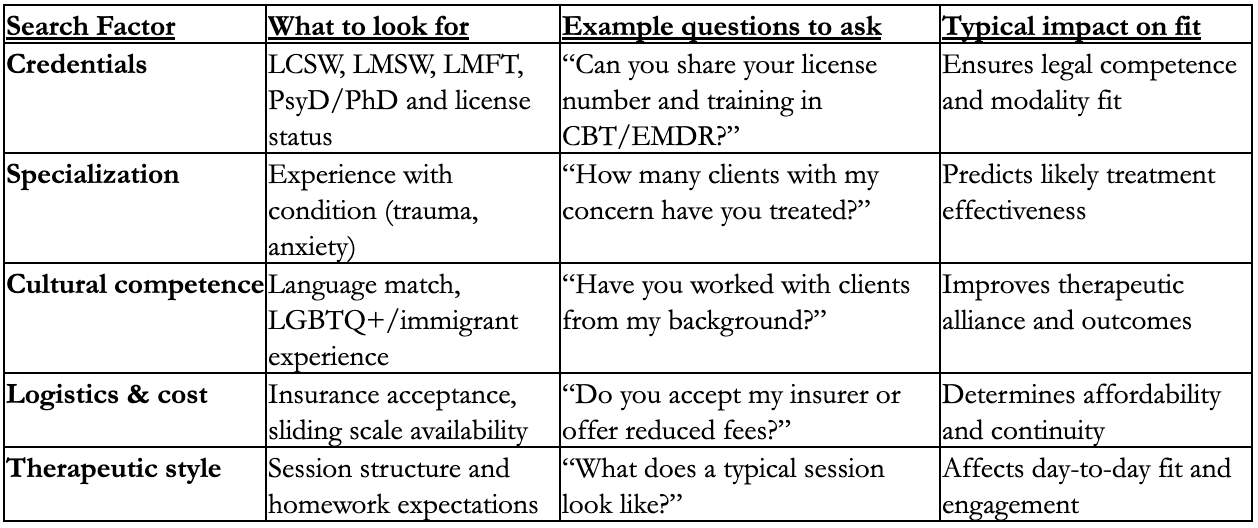
Evaluation factors for comparing online and in-person therapists
A short transition to cost considerations follows, since logistics and affordability often determine whether the match is sustainable.
How Does Insurance and Cost Affect Counseling Access in New York?
Cost and insurance significantly affect counseling access in New York, with per-session private fees often higher in urban areas and sliding-scale or clinic-based options providing crucial alternatives. Typical private fees vary widely, and insurance coverage depends on whether the therapist is in-network. Steps to reduce cost include checking employer and Medicaid/Medicare eligibility, using community mental health centers, searching for trainee clinics, and asking clinicians about sliding-scale availability. Knowing the administrative steps streamlines access and reduces unexpected costs.
Understanding cost pathways prepares you to act on state-funded resources and emerging programs that expand access across the city and state.
What Are the Latest Mental Health Resources and Trends in New York?
Recent mental health efforts in New York have focused on expanding capacity, integrating services into schools and primary care, and promoting culturally responsive programs. Current trends in 2024–2025 include sustained growth in teletherapy, increased emphasis on trauma-informed care and group modalities, and investment in bilingual and community-based services. Resource pathways now often include school-based mental health teams, expanded community clinic funding, and coordinated crisis response pilots. These system-level changes increase options for individuals seeking affordable and locally relevant counseling.
Key trends affecting counseling access and practice in New York include:
Teletherapy consolidation: Ongoing coverage and platform improvements increase reach.
Trauma-informed and group services: Rising demand for modalities that address complex community needs.
Culturally responsive care: Greater focus on bilingual clinicians and community-based programs.
These trends inform where you search for services and which provider qualities to prioritize, and the next subsection explains how state initiatives convert funding into services that affect everyday access.
How Is New York Supporting Mental Health Through State Initiatives?
New York's recent investments emphasize expanding behavioral health capacity through increased funding for outpatient clinics, school-based mental health programs, housing supports, and crisis services, which can reduce wait times and broaden low-cost options. These initiatives prioritize getting care closer to communities by supporting training pipelines for bilingual clinicians, funding community health centers, and piloting coordinated crisis response systems. For individuals, this means more points of entry—schools, primary care, and community clinics—and improved pathways to sliding-scale or publicly funded services. Knowing which programs exist in your area helps you target the right entry point.
State-driven capacity improvements increase local options and underpin the emerging trends we outline next for 2026.
What Are the Emerging Therapy Trends in New York for 2026?
Emerging therapy trends for 2026 in New York include continued teletherapy growth, resurgence of group programs for cost-effective care, increased integration of trauma-informed practices, and cautious adoption of AI-assisted administrative tools. Clinicians are expanding culturally responsive services, offering more bilingual and community-centered care pathways, and designing brief, skills-focused interventions. Group therapy is re-emerging as an efficient, evidence-based route to build social support, while trauma-informed care standardizes safety and pacing. AI tools are being used to streamline administrative tasks. Recognizing these trends helps consumers prioritize providers who align with evidence-based, culturally competent, and accessible models of care.
These trends suggest practical options to explore when searching for counseling and inform the last section’s common questions about cost and definitions.
What Are Common Questions About Counseling in New York?
Common questions about counseling in New York focus on cost, differences between counseling and therapy, and how to use insurance or find low-cost alternatives; clear, concise answers help people take immediate next steps. Use earlier checklists and tables for deeper guidance.
How Much Does Therapy Cost in New York City?
Therapy costs in New York City vary widely; private session fees often range from modest to high depending on clinician credentials and neighborhood, while sliding-scale clinics and trainee services offer lower-fee options. To reduce costs, NYC Affirmative Psychotherapy therapists are in-network with many insurance providers, and we have a sliding scale for those who need a reduced fee. We take these steps to increase affordability and therapy access for our clients.
What Is the Difference Between Counseling and Therapy in New York?
Counseling and therapy overlap substantially in New York; both involve licensed professionals providing psychological support. Counseling often denotes shorter-term, solution-focused work, while therapy can imply longer-term exploration of patterns and deeper psychopathology.
Credentialing overlaps—many counselors and therapists hold state licenses such as LCSW, LMSW, LMFT, PsyD, or PhD. Practical choice depends on goals: opt for counseling for situational problems and time-limited goals, and therapy for deeper relational patterns or complex trauma.
Authored by Aaron Skinner-Spain, LCSW-R
Aaron Skinner-Spain is a Licensed Clinical Social Worker and the founder of NYC Affirmative Psychotherapy. He specializes in evidence-based therapies for anxiety and trauma, providing culturally responsive care to individuals in New York. His expertise ensures this guide offers accurate, actionable insights into mental health services in NYC.