
Affordable Therapy in New York for Your Mental Wellness
Comprehensive Guide to Therapy in New York: Finding Individual, Online, and Affordable Mental Health Support
Therapy in New York covers a wide range of psychotherapy services, from individual and couples work to telehealth and community-based care, and understanding that landscape helps you find the right match. This guide explains what therapy in New York looks like in practice, how common modalities address conditions such as anxiety and depression, and pragmatic pathways for finding affordable, culturally competent clinicians. Many New Yorkers face barriers like high costs, complex insurance rules, and the need for identity-affirming care; this article offers step-by-step navigation and clear expectations to reduce those barriers. You will find concise definitions of major therapy types, guidance on searching and evaluating clinicians, a practical breakdown of costs and insurance mechanics including CPT code examples, and resources tailored to diverse communities. Each section includes actionable lists and tables to simplify decisions about in-person versus online care and to compare modalities by use-case and session structure. Throughout, semantic connections clarify how assessment, treatment planning, and follow-up fit together so you can move from uncertainty to a concrete plan for care.
What Types of Therapy Are Available in New York City?
New York offers an incredible diversity of counseling options: therapy in New York City includes a spectrum of psychotherapy modalities that address different problems through distinct mechanisms, from structured skills training to insight-oriented approaches. These modalities operate under the broader category of mental health services and are delivered via in-person clinics, private practices, and telehealth platforms to meet urban scheduling and access needs. Understanding modality fit helps you match presenting issues — such as panic, trauma, relationship conflict, or persistent low mood — to evidence-based approaches that produce measurable change. Different therapies emphasize skill acquisition, exposure, interpersonal change, or trauma processing, and choosing a modality often depends on symptom profile and personal preference.
How Does Individual Therapy in NYC Help with Anxiety and Depression?
Individual therapy for anxiety and depression in New York commonly uses evidence-based mechanisms—skill training, cognitive restructuring, behavioral activation, and exposure—to reduce symptoms and restore functioning. CBT (cognitive behavioral therapy) targets distorted thoughts and avoidance behaviors, producing measurable reductions in panic and generalized anxiety, while behavioral activation focuses on increasing rewarding activities to counteract depressive inertia. Clinicians often adapt techniques to urban stressors such as commute-related anxiety, high-pressure workplaces, and housing instability, which shape treatment prioritization and homework assignments. Initial assessment creates a treatment plan with measurable goals, and ongoing session notes and outcome tracking refine interventions over weeks to months. Clear assessment and goal-setting improve engagement and set up referral pathways if medication management or psychiatry consultation becomes necessary.
This explanation of individual therapy mechanisms leads naturally into how online delivery supports access for busy New Yorkers.
What Are the Benefits of Online Therapy Services in New York?
Online therapy in New York increases access and continuity by removing geographic constraints, offering flexible scheduling and a broader pool of specialists who provide telehealth psychotherapy across boroughs. Telehealth reduces commute time, enables evening or lunchtime sessions for working professionals, and helps people maintain care during relocations or travel while preserving confidentiality with secure platforms. Limitations include reduced suitability for some severe crises, certain hands-on trauma interventions, and situations where in-person assessment of safety is essential; hybrid models can combine in-person and virtual sessions to balance access and clinical needs. Recent studies and professional guidance in 2026 emphasize telehealth’s effectiveness for common conditions, but advise clear emergency plans and clinician competency in virtual techniques. Understanding these trade-offs helps determine whether virtual, in-person, or hybrid care is the right format for your goals. At NYC Affirmative Psychotherapy, we offer a wide range of online therapy options to fit your needs.
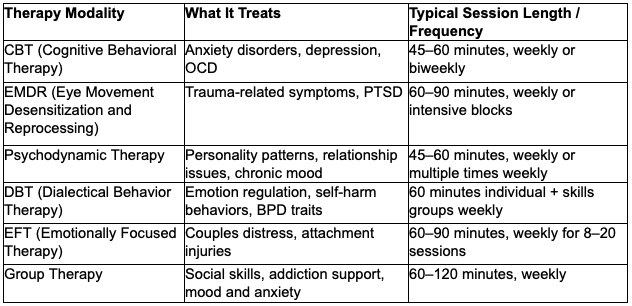
This table clarifies therapy modality differences and sets expectations for session length and frequency, which helps guide choice of initial assessment and session planning.
How Can You Find the Right Therapist in New York?
Finding the right therapist in New York requires a structured search strategy, evaluation of clinical fit, and practical checks for logistics and affordability to ensure sustained engagement. Start with directories, professional networks, and referrals while using insurance provider lists or telehealth platforms to identify clinicians with relevant licensure and specialization. Equally important are cultural competence and identity-affirming experience for LGBTQ+ and BIPOC clients, since these factors predict better alliance and outcomes. Initial consultations should cover scope of practice, treatment approach, session format, fees, and cancellation policies to evaluate practical compatibility. A clear search plan streamlines matching and reduces time spent on exploratory calls.
Below is a practical checklist to use when interviewing potential therapists:
Confirm the clinician’s licensure and specialization in your primary concern in a clear sentence.
Ask about therapeutic approach and expected course of treatment in a concise sentence.
Verify insurance status, sliding scale availability, and out-of-network reimbursement options in a direct sentence.
Discuss cultural competence, identity-affirming practices, and references for community-specific work in a straightforward sentence.
Clarify logistics such as session length, frequency, cancellation, and emergency contact procedures in one sentence.
What Factors Should You Consider When Choosing a Therapist in NYC?
Key factors when choosing a therapist include credentials, treatment approach, cultural competency, logistics, and cost structure, each of which influences likely fit and outcomes. Credentials such as licensed psychologist, LMSW, LCSW, or LMFT relate to scope of practice, while specialization ensures relevant experience for conditions like trauma or couples distress; this hierarchy maps hyponyms like individual therapy NYC and couples therapy NYC under the broader hypernym of psychotherapy. Cultural competence and identity-affirming care improve engagement for marginalized groups, and practicalities (like distance, schedule, fees, and insurance) determine sustainability of care. Asking targeted intake questions about outcomes tracking and treatment milestones clarifies what to expect and how progress will be measured. These considerations transition to locating specific in-person and online options across neighborhoods.
Where Are the Best In-Person and Online Therapy Locations in New York?
Locating reputable in-person and online therapy resources in New York involves mapping community clinics, private practices, university training clinics, and telehealth platforms that serve borough-specific populations and needs. Community mental health centers and training clinics often provide sliding scale fees and bilingual services, while private practices may offer specialized modalities and evening hours for professionals. When searching, prioritize clinics that publish scope of services, evidence of cultural competency, and clear billing practices; telehealth providers should demonstrate secure platforms and licensed clinicians practicing in New York (this is how we operate at NYC Affirmative Psychotherapy). Mapping options by neighborhood and transport accessibility helps choose offices that support consistent attendance and privacy. Knowing these search strategies prepares you to evaluate cost and insurance tradeoffs described next.
What Are the Costs and Insurance Options for Therapy in New York?
Therapy costs in New York vary widely by clinician credentials, modality, session length, and neighborhood, and understanding insurance mechanics — especially in-network versus out-of-network reimbursement — is essential for budgeting. Typical per-session ranges depend on service type, and CPT codes guide billing and claims; for example, family therapy sessions may use CPT code 90847 when billing applies. Determining whether a provider is in-network affects co-pay amounts and deductible responsibilities, while out-of-network clinicians may accept direct payment and provide superbills for reimbursement.
Sliding scale options, community clinics, and training clinics offer lower-cost pathways for those with financial constraints. The table below compares common service types with typical price ranges and insurance/sliding-scale likelihood to help plan expenses.
Before the table, note that costs are shaped by clinician experience and location and that verification with insurance is required prior to starting care to avoid surprises.
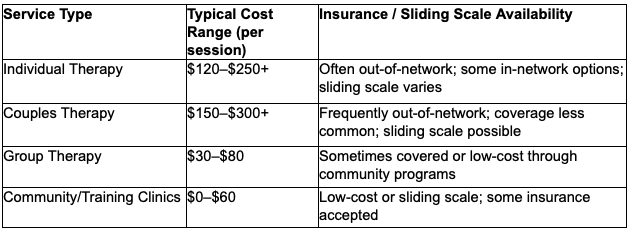
This cost comparison highlights how service type and setting influence price and access, and it frames the next practical section on detailed cost drivers and insurance verification steps.
How Much Does Individual and Couples Therapy Cost in NYC?
Individual therapy prices reflect clinician credentials, demand, and neighborhood rent levels, with licensed clinicians in Manhattan often charging at the higher end and community clinics offering lower rates. Couples therapy typically sits above standard individual rates because of session length or specialized training required, and some providers charge premium rates for intensive or weekend sessions. Session duration matters—45, 50, or 60- to 90-minute sessions shift per-session cost and expected frequency—and credentialing (e.g., psychologist vs. social worker) also influences rates. When budgeting, ask clinicians about sliding scale policies, reduced-fee slots, and whether they provide superbills for insurance reimbursement. At NYC Affirmative Psychotherapy we aim to make our rates, sliding scale and reduced-fee options clear, but at some practices you may need to ask. Understanding these drivers helps you compare value across options and plan for long-term care.
Is Therapy Covered by Insurance in New York?
Insurance coverage for therapy in New York depends on your plan, provider network status, and specific benefits such as mental health parity provisions; verifying benefits requires checking in-network directories and calling member services. If a therapist is in-network, co-pay and deductible rules apply and sessions may be billed directly; if out-of-network, many clinicians provide a superbill so you can file for partial reimbursement based on your out-of-network mental health benefits. Employee Assistance Programs (EAPs) and some employer plans offer short-term coverage that can bridge initial access to longer-term care. For couples therapy, coverage is less consistent and may require alternative billing codes or separate sessions for individual partners; ask your insurer and clinician about how it is handled under your plan. Clear verification steps reduce surprise bills and help you choose between in-network savings and out-of-network specialist access.
[Read more on our blog about understanding insurance.]
How Does Therapy Address Specific Conditions Like Anxiety and Depression in NYC?
Therapy for anxiety and depression in New York relies on evidence-based modalities tailored to urban stressors, with clinicians combining structured skills, behavioral activation, and trauma-informed care to address symptom clusters. Many therapists blend CBT with mindfulness-based approaches or incorporate EMDR when trauma underlies mood and anxiety symptoms, adapting interventions for shift workers, commuters, and densely populated living situations. Treatment plans begin with an initial assessment, produce a measurable treatment plan, and use session notes and periodic outcome measures to adjust interventions. When medication or psychiatry consultation is indicated, therapists coordinate referrals while maintaining psychotherapeutic continuity. These clinical pathways reflect both vertical depth in intervention choice and horizontal breadth across related support services.
What Therapy Modalities Are Effective for Anxiety Treatment in NYC?
CBT and exposure-based therapies are primary interventions for anxiety disorders, reducing avoidance and correcting catastrophic thinking through structured practice and graduated exposure tasks tailored to daily urban triggers. Acceptance and Commitment Therapy (ACT) and mindfulness-based interventions support tolerance of uncomfortable internal experiences, which is useful for chronic worry and performance anxiety common among professionals. For trauma-related anxiety, EMDR and trauma-focused CBT address disturbing memories and physiological arousal, sometimes requiring longer sessions or in-person work for safety reasons. Practical CBT skills for city living—sleep hygiene for shift workers, commute anxiety planning, and workplace boundary-setting—translate evidence-based techniques into everyday habit changes. These modality choices inform expected session structure and homework assignments during treatment.
How Is Depression Therapy Tailored for New Yorkers?
Depression therapy commonly uses behavioral activation and interpersonal therapy to reintroduce rewarding activities and address relationship or role conflicts that maintain low mood, adapting interventions to urban routines and time constraints. Behavioral activation focuses on scheduling manageable, reinforcing activities despite limited free time, and clinicians often co-create plans that fit crowded schedules, long commutes, and constrained budgets. Addressing social isolation among young adults involves linking clients to group therapy, peer supports, or community resources, while telehealth options improve engagement for those with mobility or scheduling issues. Clinicians also plan for crisis supports and coordinate with community mental health services when access or safety concerns arise. Tailoring increases relevance and adherence, improving outcomes in the city context.
What Specialized Therapy Services Are Available for Diverse New York Communities?
New York offers a range of specialized therapy services that prioritize cultural competence, identity-affirming care, and population-specific programs to meet diverse community needs and reduce access disparities. Providers and clinics increasingly offer LGBTQ+ affirming therapy, BIPOC-focused services, bilingual clinicians, and young-adult-centered programs designed to address minority stress, microaggressions, and socioeconomic barriers. Training clinics and community mental health centers frequently provide sliding scale models and targeted outreach, while some programs collaborate with local organizations to connect people with culturally specific resources. Identifying markers of affirmative care—explicit statements on inclusive practice, clinician training in minority stress, and referral networks—helps clients find appropriate supports.
The lists below summarize key specialized service categories and practical features to look for when seeking culturally competent care.
LGBTQ+ Affirming Care: Providers who explicitly state inclusive practice, use correct names/pronouns, and have training in minority stress and gender-affirming histories.
BIPOC-Focused Services: Clinicians and programs that integrate cultural frameworks, address racial trauma, and offer language-congruent care when needed.
Young Adult Programs: Services designed for transitional age youth with flexible scheduling, group offerings, and vocational or academic support.
Sliding Scale and Training Clinics: Low-cost options that provide supervised care and access to evidence-based treatments with graduated fees.
How Does LGBTQ+ Affirming Therapy Support Mental Health?
LGBTQ+ affirming therapy uses identity-affirming principles that validate experiences related to sexual orientation and gender identity, address minority stress, and support transitions in a way that reduces internalized stigma and improves mental health outcomes. Affirming clinicians apply consistent use of names and pronouns, understand legal and medical referral needs, and provide support for relationship, family, and workplace challenges that commonly affect LGBTQ+ New Yorkers. Group supports and community resources are often integrated into treatment plans to reduce isolation, and clinicians may coordinate with local advocacy organizations to connect clients with social and medical supports. Choosing an affirming provider improves therapeutic alliance and increases the likelihood of sustained engagement and symptom reduction. These elements connect to broader resources for BIPOC and young adults discussed next.
What Resources Exist for BIPOC and Young Adults Seeking Therapy in New York?
BIPOC and young adults can access community mental health centers, university training clinics, and targeted programs that offer culturally responsive care, sliding scale fees, and group modalities to build peer support. Organizations focused on minority mental health provide referral networks and culturally specific interventions that address racial trauma, intergenerational stress, and systemic barriers to care. Young adults benefit from programs that combine therapy with vocational or academic assistance and flexible scheduling to accommodate education and early-career demands. When cost is a barrier, inquire about supervised trainee services, non-profit clinics, and scholarship-funded initiatives to secure lower-cost evidence-based treatment. These resource pathways create practical options before discussing format trade-offs between online and in-person services.
What Are the Pros and Cons of Online vs. In-Person Therapy in New York?
Choosing between online and in-person therapy hinges on trade-offs between access and certain clinical limitations; virtual care increases availability across boroughs but may be less suited for some intensive trauma treatments and acute safety assessments. In-person therapy supports certain interventions that benefit from direct presence, such as some EMDR protocols or nuanced nonverbal assessment, and can provide a private, neutral office space for clients in shared living situations. Telehealth offers scheduling flexibility, continuity during relocation, and the ability to reach niche specialists not available locally, making it particularly useful for busy professionals and commuters. Hybrid models blend the strengths of both formats and allow treatment plans to adapt as clinical needs change. The table below provides a concise comparison to help readers decide which format aligns with their clinical needs and practical constraints.
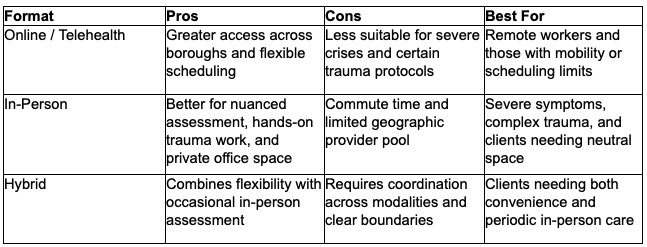
This comparison clarifies use-cases and prepares readers toward evaluating clinician capabilities and emergency planning.
What Are the Benefits of Virtual Therapy for New Yorkers?
Virtual therapy expands access to clinicians across boroughs and specialties, reduces commute-related stress, and enables evening or mid-day sessions that fit varied work schedules typical in the city. Telehealth supports continuity of care during travel or relocation and allows clients to maintain established therapeutic relationships even when distances change. Secure telehealth platforms meet privacy standards when clinicians follow documentation and confidentiality best practices, and online delivery has demonstrated effectiveness for many mood and anxiety disorders in recent research. Nonetheless, clinicians must establish clear emergency plans and assess appropriateness for clients with high-risk factors; this risk management often dictates when an in-person option is preferable. These considerations lead into scenarios where face-to-face care remains the recommendation.
When Is In-Person Therapy Preferable in NYC?
In-person therapy is preferable when clinical assessment requires observation of nonverbal cues, when interventions need hands-on elements, or when client privacy at home is compromised and an office setting provides a confidential space. Certain trauma-focused treatments and complex diagnostic work benefit from face-to-face interaction and controlled clinical environments, and some clients report stronger rapport development in person. Additionally, people in acute crisis or those with safety concerns may require direct in-person assessments and coordination with local emergency resources. For many clients, a hybrid arrangement — beginning in person and shifting to telehealth for maintenance — offers the best balance between clinical depth and ongoing access. Recognizing these scenarios helps you choose the format that aligns with both therapeutic goals and practical realities.
When to prefer in-person: Clinical complexity, requirement for hands-on protocols, or need for a neutral private space.
When telehealth suffices: Stable conditions, logistical barriers to office visits, or when specialist access is limited locally.
Hybrid approach: Start with in-person assessment, continue with telehealth for routine sessions, and return to in-person as clinical needs dictate.
—
These use-cases complete the article’s practical guidance and prepare readers to take next steps in scheduling assessments or verifying insurance benefits.
—
Written by Aaron Skinner-Spain, LCSW-R
Executive Director, NYC Affirmative Psychotherapy
Pronouns: He/Him
Education: A.B., Cornell University; M.S.W., New York University
Training: Covenant House New York-Mother and Child Program; SCO Family of Services-GLBTQ Program; SCO Family of Services East New York-High School Suspension Program; New York University Counseling and Wellness Services; Training Institute for Mental Health; Trauma Research Foundation; Parnell Institute
License: New York State #080690
Post-Graduate Training and Certifications: Executive Healthcare Leadership, Cornell University; Supervisory Training Program, Training Institute for Mental Health; Four-Year Program, Psychoanalysis, Training Institute for Mental Health; Seminar in Field Instruction (SIFI), Fordham University; Undoing Racism Workshop; The People’s Institute for Survival and Beyond
Area(s) of Expertise: college mental health, depression, anxiety, panic attacks, LGBTQ affirmative therapy, childhood trauma, acute trauma, racial trauma and stress, coping skills, AF-EMDR, clinical supervision for therapists, entrepreneur, and executive stress