
Discover In-Network Therapists Near You Now
How to Find a Therapist In Your Network: A Guide to Therapists That Accept Insurance and Affordable In-Network Therapy
Finding a network therapist who accepts your insurance can save you hundreds of dollars and reduce administrative hassle, but many people feel confused about how networks, copays, and deductibles actually affect session costs. This guide explains what an in-network therapist is, how health insurance plans typically cover therapy, and step-by-step methods to find and verify therapists in your network. You will learn practical verification scripts to use with insurers and providers, how to evaluate telehealth versus in-person in-network options, and strategies for finding affordable in-network care like sliding-scale clinics or EAP referrals. The article also covers how to choose the right in-network mental health provider for your needs, including question checklists and how specializations affect availability. Finally, we summarize policy and regulatory trends through 2024–2025 that influence network adequacy and telehealth coverage, and we provide compact comparison tables and actionable lists so you can act immediately.
What Is an In-Network Therapist and How Does Insurance Coverage Work?
An in-network therapist is a licensed mental health provider who has a contract with a health insurance plan to provide services at negotiated rates, which typically lowers your out-of-pocket cost and streamlines claims processing. The mechanism is simple: insurers set reimbursement rates and require a therapist to accept those rates in exchange for being listed as an in-network provider, and this affects your copay, coinsurance, or deductible responsibility at the point of care. Understanding these mechanics matters because the same therapy session can cost very different amounts depending on whether a provider is in-network or out-of-network. Knowing how an in-network therapist interacts with plan rules helps you predict costs and decide when to seek reimbursement or appeal a coverage decision.
What Does In-Network Therapy Mean for Mental Health Care?
In-network therapy usually means lower per-session costs, simpler billing (the provider files claims for you), and access to therapists who meet plan credentialing standards; however, it can also mean a smaller pool of available clinicians in specialty areas. Patients often trade broader choice for reduced cost and administrative ease, so the decision hinges on whether cost savings or therapist fit is the higher priority for ongoing care. In-network status also affects privacy and record-keeping because claims create documentation that goes to the insurer; this is an important practical consideration for some patients. Recognizing these trade-offs helps you decide whether to prioritize in-network matching or consider out-of-network reimbursement strategies when needed.
Benefits of choosing an in-network therapist:Lower out-of-pocket cost per session due to negotiated rates.Provider handles insurance claims, reducing patient paperwork.Credentialing requirements often ensure minimum qualifications.
Trade-offs to consider:Smaller pool of available specialists in some regions or niches.Potential limitations on preferred modalities or scheduling.Claims create records accessible to insurers, which some patients note.
These benefits and trade-offs lead directly to the next topic: how different insurance plan types determine access to in-network therapists and influence which providers you can see.
How Do Health Insurance Plans Cover Therapy Services?
Health insurance plans cover therapy using different network rules and benefit structures that change how much you pay and which providers you can access. Plan types like PPO, HMO, and EPO each have distinct network mechanics: PPOs often allow out-of-network care with partial reimbursement, HMOs typically require in-network providers and primary care referrals, and EPOs restrict coverage to providers in the plan’s exclusive network. Coverage also depends on whether your plan applies a copay for visits, counts visits toward a deductible, or charges coinsurance; these components — copay, deductible, coinsurance, and out-of-pocket maximum — form the core of therapy cost math.
PPO (Preferred Provider Organization): Usually allows flexibility to see out-of-network clinicians with higher cost-sharing.
HMO (Health Maintenance Organization): Requires in-network providers and often a referral for specialty care.
EPO (Exclusive Provider Organization): Covers only in-network services except in emergencies.
Understanding your plan type and the interplay between deductible and copay helps you calculate expected session costs. For example, if you have a $1,000 deductible and 20% coinsurance after the deductible, an in-network session billed at an allowed amount of $120 will cost less than an out-of-network session where you might be billed the full private-pay rate and face higher coinsurance. Knowing these distinctions prepares you for the verification steps that follow.
How Can You Find Therapists That Accept Your Insurance?
Finding therapists in your network requires a systematic approach: search insurer directories, cross-check third-party platforms, and verify details with both the insurer and the provider. The process reduces surprises about coverage and ensures the therapist you choose is actually listed as in-network for your specific plan. A practical verification workflow and comparison of common directory tools help you balance convenience and reliability when searching for therapists in network.
What Steps Should You Take to Verify Therapy Insurance Coverage?
Start with clear documentation of your plan name, member ID, and the specific mental health benefit details in your Summary of Benefits and Coverage. Use a numbered verification script when calling the insurer and the provider, and save reference numbers or representative names to document confirmations. Always confirm the provider's legal name, license type, NPI (if available), accepted plan names, whether telehealth is covered, and whether pre-authorization or visit limits apply. If you hit a discrepancy between an online directory and the insurer rep’s response, ask the insurer to confirm the provider’s contract status and request a network search reference.
Gather your insurance details (plan name, member ID, benefit summary) before calling.
Ask the insurer: "Is [provider legal name] in-network for my plan and does my plan cover telehealth sessions?"
Ask the provider: "Do you accept my plan for in-network care, and will you file claims on my behalf?"
Save the representative name and reference number, and request written confirmation if possible.
These steps reduce billing surprises and lead into an evaluation of where to look online—insurer portals, third-party directories, and telehealth marketplaces—that often show different insurance details.
Which Online Platforms Help You Find In-Network Therapists?
Several platform types exist for locating in-network therapists: insurer provider finders, third-party directories that aggregate provider profiles, and telehealth marketplaces that match patients to clinicians. Insurer directories typically indicate network status and plan compatibility, while third-party directories can provide richer profiles, specialties, and patient reviews but may lag on network updates. Telehealth platforms often advertise accepted insurers or offer built-in insurance verification tools, though coverage varies by insurer and region. Trust signals to look for include an explicit in-network flag, license verification, clear list of accepted plans, and recent availability updates.
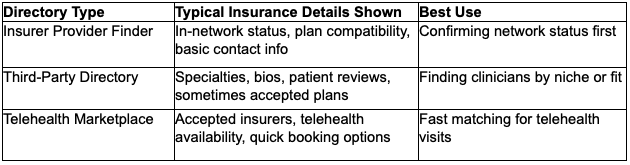
This comparison shows each platform type’s strengths and weaknesses and explains why calling your insurer and provider remains the final verification step. Practical platform examples used widely in the market include Headway, BetterHelp, Talkspace, Zencare, and Grow Therapy; these platforms often vary by insurer and region, so double-check with your plan.
What Are the Benefits and Challenges of Online In-Network Therapy?
Online in-network therapy makes therapy more accessible by removing travel barriers and expanding available providers, but it also raises considerations about licensing, privacy, and technology. Insurance coverage for telehealth expanded significantly after 2020, and by 2024–2025 most major plans include some telehealth mental health benefits, but plan details such as parity, provider lists, and state licensing restrictions still affect access. Weighing benefits and limitations helps you choose a mode of care that aligns with clinical needs and insurance realities.
How Does Online Therapy Compare to In-Person Sessions?
Telehealth matches or approximates in-person outcomes for many conditions, especially anxiety and depression, while offering convenience, reduced travel time, and access to specialists across regions. However, complex cases requiring in-person assessment, certain group modalities, or integrated medical care may still favor face-to-face sessions. Technical reliability, private space at home, and state licensing rules that limit cross-state provider availability are important practical constraints to consider. When choosing, prioritize therapeutic fit and continuity of care; if telehealth is your best access route, verify that your insurer recognizes the telehealth session as in-network.
Pros of online in-network therapy:Increased access to specialists and flexible scheduling.Often lower no-show rates and convenience for ongoing care.Easier to maintain consistent therapy during travel or relocation.
Cons of online in-network therapy:Licensing limits across state lines can restrict provider choice.Technology or privacy issues may interrupt sessions.Some therapeutic modalities or severe cases may need in-person assessment.
These comparisons lead directly into how to confirm whether your specific insurer covers telehealth and under what conditions.
Which Insurance Plans Typically Cover Online Therapy?
By 2025–2026, most large insurers adopted telehealth coverage for mental health as standard, but coverage specifics vary: some plans fully cover telehealth in-network sessions with the same copay, others apply different cost-sharing, and some require telehealth sessions to be delivered by participating in-network clinicians. Government programs and Medicare have expanded telehealth mental health allowances, yet state-level licensing and reimbursable modalities change the practical availability. To confirm, check your plan’s summary of benefits and ask the insurer whether telehealth visits are treated as in-network, whether they count toward visit limits, and whether any special codes or prior authorizations are required.
Click to view which insurance plans NYC Affirmative Psychotherapy is in-network with.
How Do You Choose the Right In-Network Mental Health Provider for Your Needs?
Choosing the right in-network therapist balances clinical specialization, modality fit, credentials, and logistics such as availability and location or telehealth capability. Start by identifying the condition or life stage you need help with (e.g., perinatal mood concerns, trauma, couples therapy), then filter in-network providers by license type and specialty.
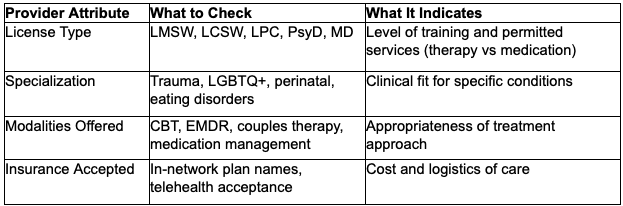
Evaluating provider attributes reduces wasted sessions and improves outcomes; see the table above for a compact comparison to guide searches and initial outreach.
What Questions Should You Ask When Vetting In-Network Therapists?
Use a short interview checklist to assess clinical fit, logistics, and insurance handling before committing to ongoing sessions; asking direct questions saves time and clarifies expectations. Confirm the clinician’s experience with your condition, typical treatment approach and timeline, session length and frequency, cancellation policies, and whether they accept your insurance as in-network. Also ask about telehealth availability, comfort with certain modalities (e.g., EMDR), and what documentation or referrals might be needed for insurance claims. Save phrases and scripts below for hassle-free calls.
"Do you accept my insurance in-network for ongoing therapy, and will you file claims on my behalf?"
"How much experience do you have treating [specific condition], and what modalities do you use?"
"What is a typical session length, frequency, and expected timeframe for seeing progress?"
These scripted questions let you compare providers directly and make an informed pick; if a specialist is scarce in-network, the next section explains how specialization affects options.
How Do Therapist Specializations Affect Your In-Network Options?
Specializations narrow in-network availability because not every network includes clinicians trained in niche modalities or populations, so finding a trauma specialist or perinatal therapist may require more searching or telehealth flexibility. If you need highly specialized care, expand searches to include telehealth specialists who accept your plan or ask your insurer for specialist directories; some plans maintain limited panels for specialty services. When a needed specialist is not available in-network, consider targeted out-of-network reimbursement strategies (e.g., superbills for partial reimbursement) while weighing cost versus the clinical benefit. Knowing when specialization warrants out-of-network investment helps you plan both care and budget.
What Are Affordable In-Network Therapy Options Beyond Traditional Coverage?
If standard in-network options are still unaffordable or unavailable, alternative pathways like sliding-scale clinics, community mental health centers, university training clinics, and Employee Assistance Programs (EAPs) can lower costs or bridge care temporarily. These routes interact differently with insurance: some accept insurance as in-network, others provide low-cost care regardless of insurance, and EAPs often offer short-term counseling separate from medical benefits. Comparing these options side-by-side clarifies which approach fits your financial and clinical needs.
How Can You Find Low-Cost or Sliding Scale In-Network Therapists?
Search local community health clinics, university counseling centers, and vetted nonprofit directories using keywords like "sliding scale" plus your city or region, and call to ask whether they accept your plan or can provide documentation for insurance reimbursement. In many cases, university training clinics offer low-cost care delivered by supervised trainees and may accept certain insurance plans or provide receipts for potential partial reimbursement. Negotiate openly with clinics about income documentation and possible fee caps, and ask employers whether EAP services can cover initial sessions that transition to in-network care.
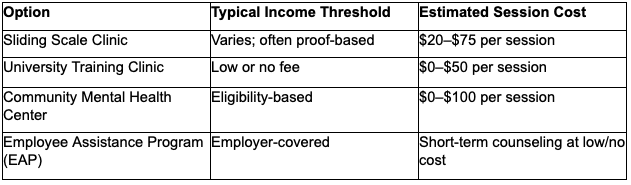
This affordability comparison shows practical costs and access paths; after using an EAP or training clinic for short-term care, transition to an in-network therapist for ongoing treatment as needed.
What Role Do Employee Assistance Programs Play in Therapy Coverage?
EAPs typically provide limited short-term counseling, crisis support, and referrals at low or no cost, making them a common first step for employees needing immediate help. EAP counseling is often confidential within employer programs, but the scope is usually short-term and focused on stabilization or referral rather than long-term therapy. To use EAP services effectively, check with your HR or benefits administrator for access steps, ask about confidentiality limits, and request in-network referrals for follow-up care that your insurer will cover. Combining an EAP’s short-term support with in-network referrals can minimize gaps and reduce overall cost when transitioning to ongoing treatment.
How Does Mental Health Parity and Recent Regulations Impact In-Network Therapy Access?
Mental health parity laws require insurers to offer mental health benefits no more restrictively than medical benefits, and recent regulatory attention through 2024–2025 has pushed enforcement on network adequacy, prior authorization limits, and telehealth parity. Parity influences whether insurers can impose stricter visit limits, higher utilization review hurdles, or narrower networks for mental health services. Understanding parity and how to cite it can empower appeals when coverage denials or overly restrictive utilization controls limit access to in-network therapy.
What Is the Mental Health Parity Act and How Does It Affect Coverage?
Parity rules mandate that financial requirements and treatment limitations for mental health services should not be more restrictive than those for medical/surgical benefits, which impacts copay structures, prior authorization practices, and network design. Recent enforcement and guidance in 2024–2025 emphasize transparency in network adequacy and utilization management, meaning patients have stronger grounds to appeal if mental health networks are demonstrably inadequate. When denied, document comparative medical benefit terms and reference parity standards in appeals to strengthen your case.
How Are Provider Shortages and Telehealth Regulations Changing Access?
Provider shortages in many regions make in-network access uneven, but telehealth expansion and regulatory adaptations since 2020 have partially mitigated geographic gaps, subject to state licensing rules and broadband availability. Telehealth allows patients in shortage areas to access specialists in other regions if state licensing permits, and some insurers now authorize telehealth parity so in-network telehealth visits carry comparable cost-sharing. Practical workarounds include requesting telehealth in-network specialists, asking for network adequacy exceptions, or using partial out-of-network reimbursement while appealing for network expansion.
Request telehealth in-network providers if local shortages exist.
Ask your insurer for a network adequacy review or exception if necessary.
Combine short-term EAP or training-clinic care with a planned transition to in-network therapy.
These tactical steps give patients concrete options when networks are sparse and lead naturally back to verification and selection strategies covered earlier in the guide.
Written by Aaron Skinner-Spain, LCSW-R
Executive Director, NYCAP
Pronouns: He/Him
Education: A.B., Cornell University; M.S.W., New York University
Training: Covenant House New York-Mother and Child Program; SCO Family of Services-GLBTQ Program; SCO Family of Services East New York-High School Suspension Program; New York University Counseling and Wellness Services; Training Institute for Mental Health; Trauma Research Foundation; Parnell Institute
License: New York State #080690
Post-Graduate Training and Certifications: Executive Healthcare Leadership, Cornell University; Supervisory Training Program, Training Institute for Mental Health; Four-Year Program, Psychoanalysis, Training Institute for Mental Health; Seminar in Field Instruction (SIFI), Fordham University; Undoing Racism Workshop; The People’s Institute for Survival and Beyond
Area(s) of Expertise: college mental health, depression, anxiety, panic attacks, LGBTQ affirmative therapy, childhood trauma, acute trauma, racial trauma and stress, coping skills, AF-EMDR, clinical supervision for therapists, entrepreneur, and executive stress
Read Aaron’s profile on our team page.